Get Full Government Meeting Transcripts, Videos, & Alerts Forever!
Get email alerts on the Demolition Tax topic
No spam. Unsubscribe anytime.
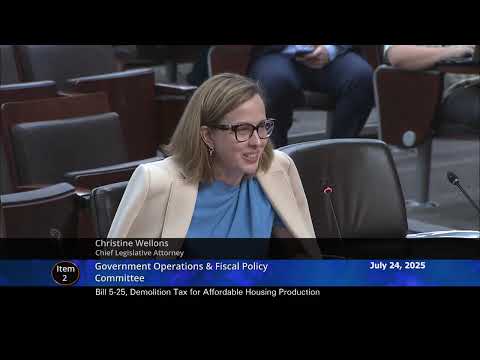
Committee advances demolition tax to fund housing production after split vote; staff and implementation questions remain
Summary
The Government Operations and Fiscal Policy Committee voted 2–1 to recommend advancing a proposed $20,000 demolition tax to help pay HOC bond contract payments and bolster the county Housing Production Fund, but members pressed staff on exemptions and who would administer the program.
The Government Operations and Fiscal Policy Committee voted 2–1 to recommend advancing a proposed demolition tax intended to support bonds issued by the Housing Opportunity Commission (HOC) and the county’s Housing Production Fund, but committee members pressed staff on exemptions, legal cross‑references and who would administer the program.
Council staff told the committee that the Department of Housing and Community Affairs and the Department of Finance had proposed clarifying language to ensure demolition‑tax revenues could be used for HOC bond contract payments and, if in excess, for the housing production fund or other Montgomery Housing Initiative purposes approved by council resolution with agreement of the county executive. Bond counsel reviewed the clarified language, council staff said.
The county attorney’s office recommended aligning definitions in the proposed new demolition‑tax section with Chapter 8 of the county code to reduce ambiguity about how “demolition” would be defined. Staff also flagged operational issues the Department of Permitting Services (DPS) would have to resolve, including how to adjudicate exemptions, what documentation or covenants would be required to qualify and whether a hardship exemption should be available when an owner cannot occupy a replacement dwelling for five years because of unforeseen circumstances such as job loss or medical condition.
Council members said DPS was not present at the meeting and several expressed frustration that the agency was not available to answer operational questions. Council member Friedson pressed staff to ensure the process for hardship or other exemptions would be clear and accessible to property owners, warning that a family facing an emergency should not be surprised by a large tax bill. Council member Mink, the sponsor, said the bill would exempt certain nonprofit homebuilders such as Habitat for Humanity and would carve out owner‑occupied rebuilds versus speculative developer flips.
Members questioned the revenue assumptions for the tax. Committee members cited testimony and local examples, noting the county sees roughly 200 teardown permits in a high year and that a typical demolition permit fee is about $150–$160; the proposed tax was described in committee materials as $20,000 per demolition. Council member Katz opposed moving the bill forward, saying a large fee would reduce volumes and citing an Evanston, Illinois, example where a similar $20,000 fee produced only modest annual revenue. Council member Friedson and others said exemptions and administrative needs could reduce net revenue and warned the bill might require DPS staff resources not currently budgeted.
Council staff said they would follow up with DPS after the meeting. The committee recorded a 2–1 recommendation to advance the proposal to full council. No final council action was taken at the committee meeting.