Get Full Government Meeting Transcripts, Videos, & Alerts Forever!
Get email alerts on the Labor Peace Agreements topic
No spam. Unsubscribe anytime.
Joint committee amends and endorses LPA requirement for county-involved hotel projects
Summary
A Montgomery County joint committee unanimously amended and recommended Bill 22-25, which would require labor peace agreements for hotel or conference center projects where the county has a proprietary interest; members narrowed executive discretion and raised the proprietary-interest threshold to $1 million.
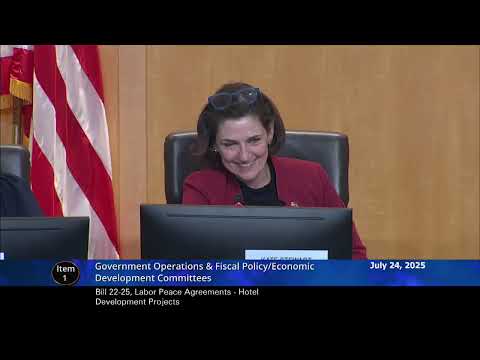
A Montgomery County joint committee on government operations, fiscal policy and economic development unanimously recommended an amended version of Bill 22-25 on labor peace agreements for hotel development projects, the committees heard on a single-item agenda.
The bill would require employers at hotel or conference center projects to enter into labor peace agreements when the county has a proprietary interest in the project, to avoid strikes, lockouts or other labor actions that might affect the county’s financial stake, legislative staffer Ms. Wellens told the joint committee.
The committee removed a broadly worded “catchall” provision that would have let the chief administrative officer (CAO) require labor peace agreements in any instance the CAO determined the county had a ‘‘significant and ongoing economic and nonregulatory interest.’’ Councilmember Friedson moved to strike the paragraph; Councilmember Balcom seconded, and the committees voted unanimously to delete that subparagraph.
The committee also narrowed the bill’s trigger language. Sponsors amended the definition of the county’s financial test, replacing the draft’s $100,000 present-value threshold with an annual proprietary-interest threshold of $1,000,000 and replacing the term “ongoing revenue” with “operating profit based on the financial performance of the project,” Councilmember Friedson said when offering the amendment. The amendment passed unanimously.
The bill as revised continues to give the CAO authority to determine whether an LPA is required in specific circumstances, subject to two explicit tests in the draft: (1) whether the present value of the county’s proprietary interest meets the numeric threshold and (2) whether the CAO determines that the county’s remaining financial or nonregulatory interest is ‘‘so minimal or speculative’’ that an LPA would not support the county’s proprietary interests. Ms. Wellens explained that the second test is intended to allow case-by-case judgments when the monetary test does not capture all relevant risks.
Members debated how that discretion should be exercised and whether the executive branch should be required to seek legal or financial opinions before a CAO determination. Councilmember Sales asked whether comparable jurisdictions use the same approach; Ms. Wellens said the drafting was modeled on Baltimore City and that Prince George’s County and the District of Columbia use similar language, with Prince George’s and D.C. using a $1,000,000 threshold in their laws. Executive-branch representative Mr. Hartman Espada said he would expect the administration to seek county-attorney advice in complex cases and described how the administration treats similar LPAs for county trash collection contracts.
Committee members asked for additional materials before a full-council vote, including (1) examples of LPA language and implementation from nearby Virginia jurisdictions, (2) any fiscal or economic-impact analyses from Baltimore or other jurisdictions, and (3) the county-executive office’s legal advice previously relied on in negotiations such as the conference center/hotel discussions. Councilmember Friedson and others expressly requested the county-executive legal opinion that informs the administration’s statement that it lacks the authority to require an LPA absent council action.
The committees also accepted a technical amendment clarifying the phrase “nonregulatory interest,” specifying that an interest arising from the exercise of regulatory police powers (for example taxation, zoning, or permits) is not an economic nonregulatory interest, with the draft explicitly excepting TIFs as described in the staff memo.
With the amendments, the joint committees voted unanimously to recommend the bill to the full council. Sponsors and staff said, and members acknowledged, that the bill would not reach the full council until September after the committee recess, giving time for the follow-up information requested by members.
The record of the committee’s discussion includes multiple references to Baltimore City, Prince George’s County, the District of Columbia, Viva White Oak (a proposed TIF district), and negotiations involving Marriott, all of which were discussed as background or precedent by members and staff.
Ending note: The amended Bill 22-25 will be forwarded to the full Montgomery County Council with a unanimous recommendation from the joint committees; committee members requested additional comparative language samples and fiscal-impact information before final council action.