
Eversource and UI report deployment totals and higher Connecticut installation costs as ITC availability wanes for owner‑occupied systems
Get AI-powered insights, summaries, and transcripts
Subscribe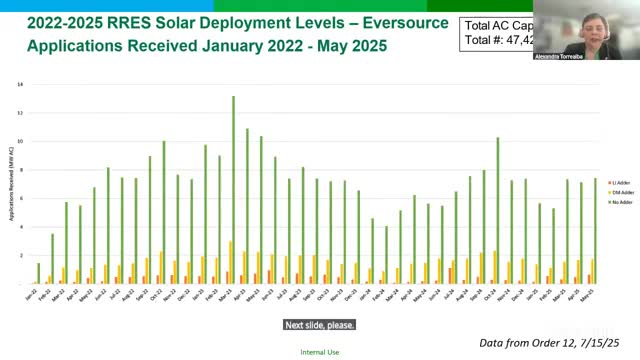
Summary
Utilities presented January 2022–May 2025 application and deployment data, said average installed costs in Connecticut remain above national averages, and warned the residential investment tax credit will likely be unavailable to many projects starting in 2026.
At PURA's May 1 technical meeting, Eversource and United Illuminating provided multi‑year figures for the Residential Solar (RS) program and discussed cost trends regulators will use for upcoming rate setting. Eversource reported 47,426 applications since January 2022 representing about 381.9 megawatts AC and said it has deployed 36,355 systems (about 290 MW AC). United Illuminating reported 10,360 applications and 4,303 systems deployed (about 101.13 MW applied, 30.4 MW deployed). Utilities also reported counts of projects using program adders: Eversource said 7,274 projects included a distressed‑municipality adder (49.6 MW) and 1,625 projects included the low‑income adder (11.7 MW). UI reported 2,596 distressed‑municipality adder projects (16.12 MW) and 170 low‑income adder projects (1.13 MW). Costs and filings: EDCs told PURA that reported average installed system costs have fallen slightly from 2024 to 2025 but remain above national averages; utilities cautioned that cost data come from developer‑reported figures rather than independent audits. Utilities said they will file an expanded cost breakout (by project and by ownership type) in the Order 6 filing due August 1, 2025. Eversource reported an 11 percent capacity factor for the past year, calculated on DC system size, consistent with prior reporting. Federal tax changes and expectations: presenters told the authority that the residential investment tax credit (ITC) is expected to be unavailable to most residential projects beginning in 2026, although impacts will vary by ownership type. Utilities and an industry stakeholder said that change will affect owner‑occupied projects and could push more activity toward third‑party ownership or accelerate cost‑reduction efforts. On differences between territories, PURA staff asked whether developer composition could explain UI's higher reported installed costs in 2024 and 2025. Utilities replied that installation cost numbers are market data reported by developers and that EDCs are not in a position to explain pricing decisions by individual firms; the utilities said their Order 6 filings will include installer‑level volume that can inform comparisons. PURA offered no final rate determinations at the session. Staff and commissioners asked follow‑up questions and invited stakeholder comments on whether to standardize net savings calculations for contractor disclosure forms and whether to include a separate calculation for low‑income customers when assessing claimed savings.