
Utilities and PURA staff raise concerns about solar leases for low‑income customers, urge stronger protections
Get AI-powered insights, summaries, and transcripts
Subscribe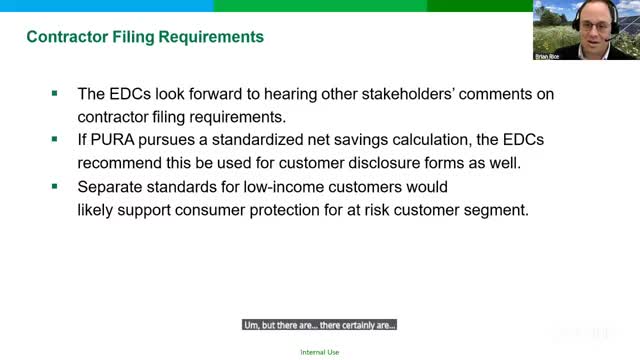
Summary
Eversource and UI told PURA they have seen instances where low‑income customers could pay more under long leases than under discounted utility rates; stakeholders recommended better disclosure, program alignment and possible involvement of consumer protection authorities.
At a May 1 technical meeting, Public Utilities Regulatory Authority staff and utility presenters warned that some low‑income customers may be steered into solar lease products that are uneconomic compared with the low income discount rates available from utilities. Eversource officers described individual cases in which lease payments effectively cost more per kilowatt‑hour than the customer's utility rate, raising concerns about marketing and disclosure to vulnerable households. Brian Rice, director at Eversource, described an illustrative case: "A customer signed a fixed price lease that when you divided that by estimated production, came out to roughly 38 cents per kilowatt‑hour for year one, with a 3 percent escalation thereafter." Rice said the customer in that instance likely was eligible for a low income discount rate and could have — in some cases — benefited more from enrolling in affordability or efficiency programs than from the lease. Why it matters: Connecticut's low income discount rate (LIDR) can substantially lower a household's retail electric rate; if savings analyses shown to customers use a nondiscounted rate, customers on LIDR may be led to accept long-term solar contracts that raise their total energy cost. Utilities told PURA they review customer disclosure forms for completeness but do not evaluate whether a commercial contract is in a customer's long-term financial interest. "We're reviewing for completeness. We're not taking an opportunity to reach out to a customer and question why they're leasing a PV system," said a utility presenter, describing the limits of the EDCs' administrative role. PURA staff and some commissioners suggested the Department of Consumer Protection or the Attorney General could play a role in investigating predatory marketing; Eversource said it will make disclosure forms available to regulators on request. Stakeholders recommended policy fixes: require savings calculations that use the customer's actual LIDR rate when the customer is enrolled in that discount, provide standardized contractor disclosures, and coordinate with consumer protection agencies to investigate systemic problems. A stakeholder who filed written comments also recommended that customers in the higher LIDR tiers be routed to a bi‑tariff or alternative payment mechanism rather than a standard netting tariff, where the economics are more likely to produce consumer benefit. No formal enforcement authority was exercised during the meeting. Utilities and PURA staff asked for input from consumer advocates and DCP on whether new oversight or reporting requirements are needed for contractor marketing and for data that would allow regulators to identify patterns by installer.