Get Full Government Meeting Transcripts, Videos, & Alerts Forever!
Get email alerts on the Ada Transition Plan topic
No spam. Unsubscribe anytime.
Shelton staff present ADA transition plan estimating $46 million to reach full right-of-way compliance
Summary
Assistant Public Works Director Aaron Nix told the Shelton City Council at a July 22 study session that the city’s ADA transition plan inventory shows roughly 1,295 curb ramps and 37.4 miles of sidewalk in city limits and estimates about $46 million to reach full right-of-way compliance.
Assistant Public Works Director Aaron Nix told the Shelton City Council at a July 22 study session that the state now expects jurisdictions to develop an Americans with Disabilities Act (ADA) Transition Plan and that Shelton has completed a citywide inventory focused on sidewalks and other public right-of-way facilities.
The inventory covers 37.4 miles of sidewalks and about 1,295 curb ramps in the city limits, Nix said, and identified roughly 733 curb ramps as well as a citywide mix of compliance levels. "The grand total in 2025 dollars is about $46,000,000, is what it will take us to get basically fully compliant with everything in address," Nix said.
The plan described by Nix includes a self-evaluation, a barrier inventory, prioritization, a barrier-removal schedule and a public engagement component. Nix said the plan addresses pedestrian elements in the public right of way — sidewalks, curb ramps, pedestrian push buttons and crosswalks — and does not address park facilities or bicycle infrastructure.
Nix said the city hired Transpo to perform field data collection, training of local data collectors, quality control and prioritization. He said the consultant mapped barriers into the city GIS so the inventory can be maintained as a living document and progress tracked as projects are completed.
Nix described the compliance breakdown in the inventory: "About 56% of the total amount of curb ramps have significant compliance issues," he said, while about 26% are minor noncompliant and roughly 17% meet current standards. For sidewalks he said about 1.8 miles (roughly 5%) were classified as significant compliance issues, with larger shares in the minor noncompliant category.
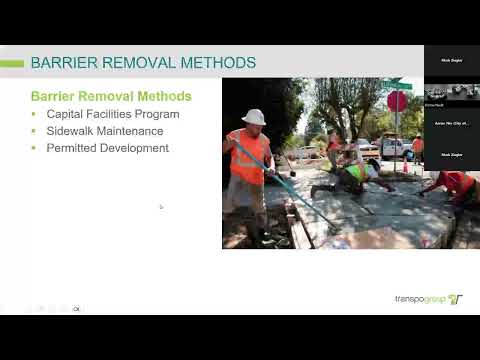
The presentation laid out funding pathways the city commonly uses: capital projects that already reconstruct rights of way, developer-required frontage improvements tied to permit work, operations and maintenance funding, and grants. Nix said Shelton’s typical annual budget for sidewalk maintenance has been around $20,000, and that under existing maintenance and capital contribution levels it could take many decades to address high-priority items. He presented rough annual funding equivalents for the $46 million estimate: about $435,000 per year for 30 years, $690,000 per year for 20 years or about $1.5 million per year for 10 years.
Nix stressed the state requirement is to demonstrate the city "is doing something" toward barrier removal and that courts may ultimately decide whether any jurisdiction’s effort is sufficient. He described a programmatic option in the plan — the "maximum extent practicable" (MEP) analysis — which can be used when older facilities were compliant under past standards.
Council members and the mayor emphasized the plan’s eligibility value for state transportation funds. Nix said Shelton must adopt the transition plan locally and then will be eligible to apply for state transportation grants that can leverage local dollars. He said the city intends to bring the plan forward for formal adoption at a future council meeting.
Public engagement for the plan included an online questionnaire that generated 19 responses (84% from city residents), with respondents calling out government buildings, medical facilities, parks and schools as key destinations. Nix said the consultant provided planning-level cost estimates in appendices and that the city will use the plan to prioritize barrier removal when capital projects occur.
Council members asked about the geographic scope (the inventory covers only city corporate limits, not the urban growth area), about how projects might be funded if a local ballot measure fails, and about the ability of the plan to show good-faith effort to the state. Nix said the city will continue to prioritize improvements through capital projects already planned for some streets and will use the GIS inventory to document progress for the state.
Ending: The council did not vote on the plan at the July 22 study session. Staff said they will return with the transition plan for formal local adoption and presented the plan as a prerequisite for state grant eligibility; adoption was described as a pending action for a future regular meeting.