Get Full Government Meeting Transcripts, Videos, & Alerts Forever!
Get email alerts on the Rezoning topic
No spam. Unsubscribe anytime.
Huntersville planning board backs rezoning at 12300 McCord Road to allow farmhouse cluster
Summary
The Huntersville Planning Board on July 22 recommended approval of a general rezoning at 12300 McCord Road from General Residential to Transitional Residential, a change the property owner said will allow a farmhouse cluster of up to six lots and make the parcel easier to market and sell.
The Huntersville Planning Board on July 22 recommended approval of petition R25‑061 to rezone 12300 McCord Road from General Residential (GR) to Transitional Residential (TR), a change applicants say would allow a future farmhouse cluster of up to six lots. The board’s recommendation advances the application to Town Board final action, scheduled by staff for Aug. 19.
Why it matters: The zoning change would alter permitted uses and density on an 11‑acre property and could enable a farmhouse‑cluster subdivision that is currently not allowed in GR. That would affect nearby single‑family neighborhoods and the property owner’s ability to market and sell the land.
Staff summary and intent: A Planning Department staff member presented the application and entered the staff report into the record, saying the request is “consistent with policies LU 1.1 and 2.1” of the Huntersville 2040 Community Plan and lies within the town core character area and near the I‑77/NC‑115 corridor. Staff noted site‑specific development standards would be required when a specific development plan is later submitted.
Applicant’s intent: Robert De Veil, the property owner, told the board he and his spouse own the 11‑acre parcel and are seeking flexibility to sell it. “We just wanna be able to have option to, like, sell it, make money, get out,” De Veil said. He said two potential builders previously “walked away” after reviewing farmhouse‑cluster rules that require substantial open space, and described the rezoning primarily as a way to make the parcel marketable.
What TR allows that GR does not: Staff explained that TR permits building forms and densities the property’s owners hope will support a farmhouse cluster; the farmhouse cluster form has a maximum of six lots and lower minimum lot sizes than GR. Board members pressed staff on what other uses TR would allow by right — for example, bed‑and‑breakfast inns, family care homes and certain boarding/rooming houses — and the limits on attached housing types. Staff clarified that a general rezoning does not require a site plan and that conditional rezoning would be the path to lock a single use or narrower commitments if the applicant desired.
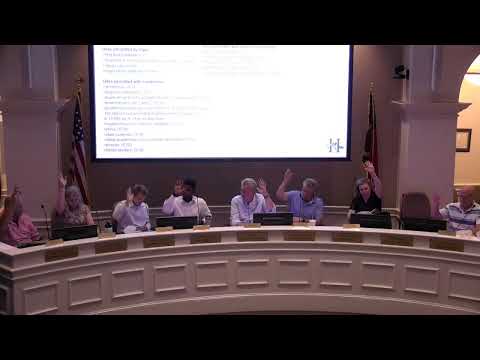
Board debate and vote: Board members who supported the rezoning said it would be compatible with surrounding densities and would help the owners market the property to buyers who could build a farmhouse cluster. One member argued the application was a “preemptive upzoning” and said rezoning without a specific plan can inappropriately change long‑term land‑use expectations. After discussion the board voted to recommend approval; the chair announced, “The motion carries. 7–1.”
Next steps: The Planning Board’s recommendation advances the petition to the Town Board, which staff said is tentatively scheduled to take final action on Aug. 19. If the Town Board approves, subsequent site plans or conditional rezonings would be required to establish a specific development layout and applicable site standards.
Details from the hearing: Staff noted TR would allow a higher density than GR and that the farmhouse cluster option fits the parcel’s size and frontage requirements. Staff also said an applicant could sell the property to a developer who could submit site plans for any permitted TR use; some uses may trigger additional studies such as traffic impact assessments.
Board members and neighbors: Direct neighbors reported they were not opposed to five or six higher‑end homes, saying they expect those homes to be consistent with nearby values. Board members repeatedly clarified they cannot add conditions to a general rezoning and that conditional rezoning remains an option if the applicant wants a narrower set of permitted uses.
Staff contact and record: Staff recommended approval and recorded the application as R25‑061 for 12300 McCord Road. The Planning Board recommendation will be included in the Town Board packet for the August hearing.