
Administration urges $1.185 billion authorization for roads, bridges and local Chapter 90 aid
Get AI-powered insights, summaries, and transcripts
Subscribe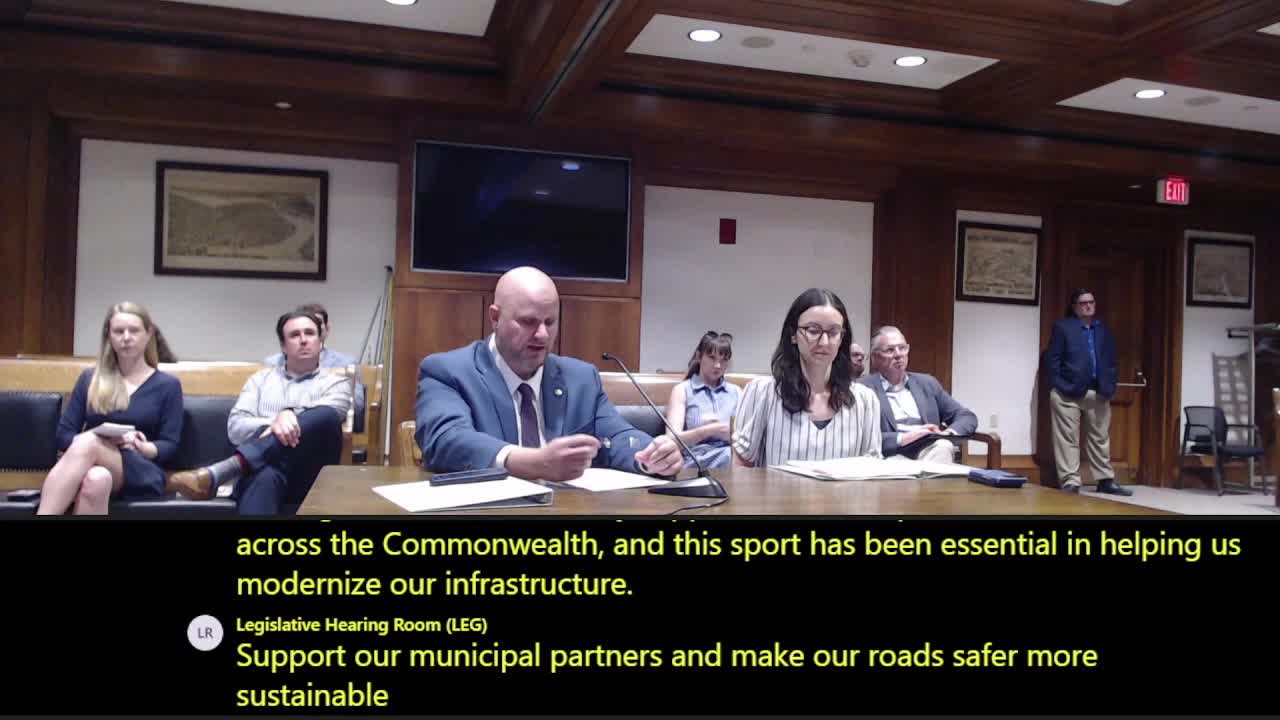
Summary
State transportation and budget officials told the Joint Committee on Bonding, State Assets and Capital Expenditures on July 21 that they support House Bill 4257, a proposal to authorize $1,185,000,000 in transportation investments for municipalities and statewide projects.
State transportation and budget officials told the Joint Committee on Bonding, State Assets and Capital Expenditures on July 21 that they support House Bill 4257, a proposal to authorize $1,185,000,000 in transportation investments for municipalities and statewide projects.
Jonathan Gulliver, State Highway Administrator, told the committee, “This bill proposes a total authorization of $1,185,000,000 to support both municipal and statewide transportation priorities,” and outlined the bill’s main elements: $300 million for the Chapter 90 local-aid program (split as $200 million via the traditional Chapter 90 formula and $100 million allocated by local road mileage), $500 million for bridge and pavement lifecycle asset management, $200 million for culvert and small-bridge modernization, and $185 million for congestion and multimodal safety projects.
Why it matters: committee members and municipal representatives said the funding would provide predictable, flexible resources towns rely on to plan and deliver road and sidewalk work. Caitlin Connors, Assistant Secretary for Capital at the Executive Office for Administration and Finance, said the central proposal increases Chapter 90 support to $300 million annually and would allow the state to use the Commonwealth Transportation Fund to help finance the program, consistent with the administration’s larger plan to leverage fair-share revenues for capital.
Details and administration commitments: MassDOT officials said the bill would preserve the standard Chapter 90 distribution for the first $200 million and dedicate the additional $100 million to a road-mile-only allocation intended to benefit rural communities that lack employment-based formula credits. Gulliver said MassDOT will provide earlier notification of awards ahead of construction seasons and will continue streamlined reimbursement processes to help municipalities move projects into construction without delay. When a senator raised a specific local request for culvert funding in Dunstable, Gulliver said MassDOT would follow up with the municipality to review any preexisting earmark and discuss options.
Officials described the $500 million bridge and pavement authorization as funding to keep assets in a state of good repair and said the $200 million culvert and small-bridge authorization is intended to support climate-smart designs for structures under 20 feet—citing recent flooding in Quincy, Leominster and other parts of the state as evidence of vulnerability. The $185 million package for congestion and safety was described as flexible funding for intersection work, ADA-compliant sidewalks, shared-use paths and traffic technology on state and municipal roadways.
Financing and bond questions: members pressed administration witnesses about how the bill would be financed. Connors said the Department of Revenue and administration teams are considering the mix of general obligation (GO) bonds and special obligation bonds secured by dedicated “fair share” revenues (the proposed use of a subsection of those revenues for securitization). She said the current capital plan includes Chapter 90 at $200 million in GO bonds but that the bill’s increase to $300 million could be supported by shifting some issuance to a Commonwealth Transportation Fund (CTF) special-obligation structure in order to avoid pressure on the Commonwealth’s statutory direct-debt limit.
Connors and other administration staff said special-obligation bonds would be paid from the identified dedicated revenue stream (fair-share collections) and that rating agencies evaluate those bonds on their own coverage ratios; the administration’s modeling anticipates a strong credit for any special-obligation issuance and does not expect an adverse impact to the Commonwealth’s GO credit rating.
Local governments and industry reaction: Dave Kaufman of the Massachusetts Municipal Association said municipalities “appreciate” the increase in Chapter 90 support and urged the committee to move the bill quickly so cities and towns can plan projects. Chuck Lapvis of the Massachusetts Aggregate and Asphalt Pavement Association said the industry supports the one-year $300 million authorization and the lifecycle, culvert and congestion funds, and warned that construction costs—particularly liquid asphalt—rose sharply around and after the COVID period and remain elevated on many projects.
What the committee did: the hearing recorded testimony from the administration, municipal association representatives and industry groups; no formal vote on the bill occurred during the session. Chair Finn said he would begin a poll to move the measure quickly. A procedural motion to adjourn the hearing was seconded and approved by voice vote.
Next steps: the hearing record will be available to committee members as they consider amendments, bond-authorization language and the financing mix. MassDOT and administration staff said they will follow up with municipalities that have identified specific projects or prior earmarks.