Lifetime Citizen Portal Access — AI Briefings, Alerts & Unlimited Follows
Advocates press committee to enact Language Access and Inclusion Act as federal rollbacks raise stakes
Loading...
Summary
A coalition of advocates told the joint committee that the Language Access and Inclusion Act would mandate interpreters, translated vital documents and language‑access plans at selected state agencies to ensure meaningful access for residents with limited English proficiency.
A broad coalition of civil‑rights, legal‑services, public‑health and immigrant‑advocacy groups urged the Joint Committee on State Administration and Regulatory Oversight to report favorably on the Language Access and Inclusion Act, H.3384 / S.2125.
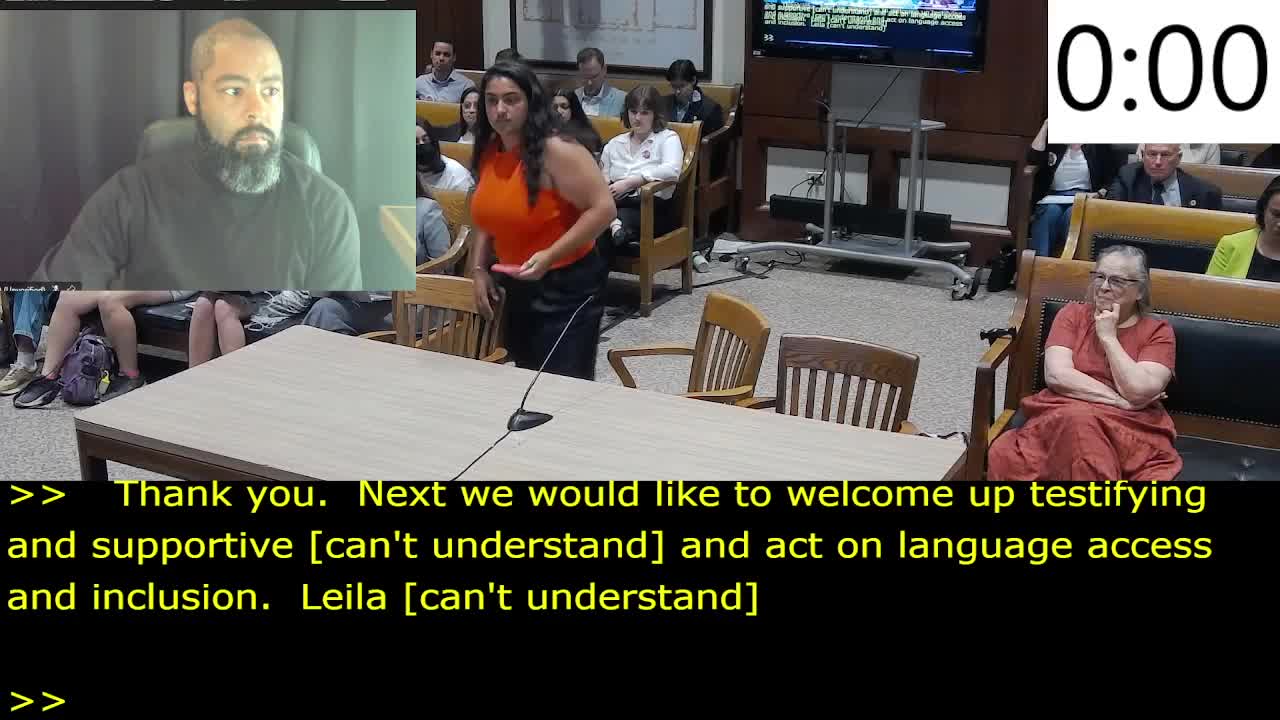
"Our community members shouldn't be afraid of the government because of something as basic as language barriers," said Leila Ramachandran, policy director for the Massachusetts Asian American and Pacific Islander Commission.
Witnesses described five core provisions in the draft bill: mandatory interpretation services and translation of vital documents; agency language‑access plans informed by regular data collection and assessments; a requirement that agencies employ a full‑time language‑access coordinator; creation of a language‑access advisory board including community members and service providers; and an implementation plan that initially applies to several essential state agencies and expands over time.
Speakers cited concrete consequences of limited English proficiency (LEP). Miriam Barrett Krugman of Mass. Appleseed described a 2021 report finding that an interpreter was present in only 25 percent of Department of Children and Families (DCF) LEP home visits and that translated vital documents were frequently unavailable; a 2024 follow‑up survey of attorneys reported 63 percent said key services were only sometimes available in a client's language, 83 percent said important DCF documents were never translated, and 38 percent rated interpretation quality as poor.
Several witnesses said recent federal actions increase the need for state standards: advocates referenced a March 2025 executive order (E.O. 14224) declaring English the official language of the United States and rescinding prior federal LEP guidance. Kate Cressy of the Massachusetts Law Reform Institute said Title VI of the Civil Rights Act has long prohibited discrimination based on national origin (which covers language), but recent federal guidance made state action more urgent.
Local governments and service providers described operational burdens: the Asian Task Force Against Domestic Violence reported that multilingual staff spend up to 60 percent of their time bridging language gaps caused by state systems; advocates said bilingual staff and small nonprofits frequently shoulder interpretation work that agencies do not provide. Municipal representatives and regional planners told the committee they want consistent, funded statewide standards to help monitor demand and secure qualified interpreters.
Speakers urged the committee to require agency language‑access coordinators, set measurable standards, and include community input and enforcement mechanisms. Several witnesses said the governor’s 2023 executive order on language access was a positive step but lacks enforceable standards and community representation required by the bill.
Ending: The volume of testimony, including concrete examples and legal references, indicated broad coalition support for the bill. Sponsors and advocates urged the committee to report H.3384 / S.2125 favorably so the state can build consistent, enforceable language‑access systems across agencies.