
Mass. library leaders say federal IMLS cuts will end statewide databases, cancel grants and threaten staff
Get AI-powered insights, summaries, and transcripts
Subscribe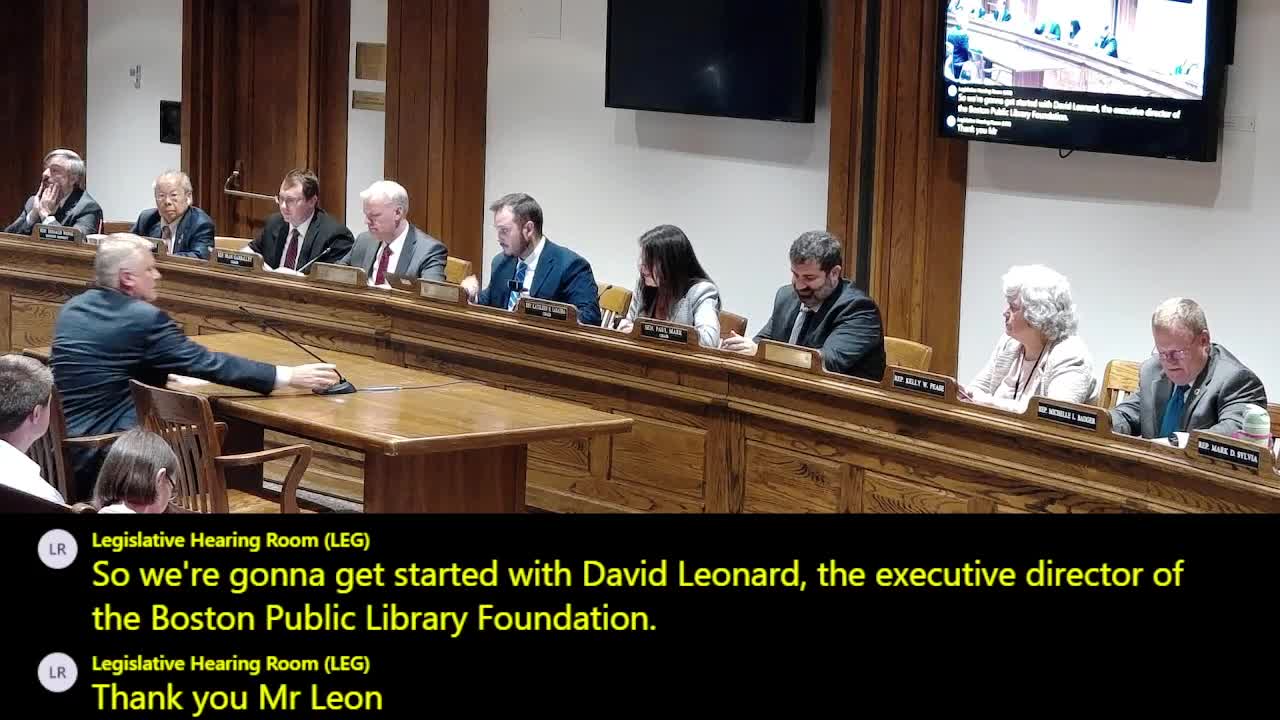
Summary
Library officials told a joint legislative hearing that the elimination and pause of Institute of Museum and Library Services funding has forced Massachusetts to cancel competitive grants, cut statewide research databases and put dozens of MBLC-paid positions and local services at risk.
State library leaders told a joint legislative hearing that abrupt federal changes to Institute of Museum and Library Services funding have already removed grants, forced cuts to statewide online resources, and put agency staff positions at risk.
"The Boston Public Library also serves as the library for the Commonwealth," said David Leonard, president of the Boston Public Library, testifying that two National Endowment for the Humanities grants totaling $500,000 were canceled and that the library can no longer guarantee statewide access to several subscription databases that schoolchildren and students rely on.
The Massachusetts Board of Library Commissioners (MBLC) and public library directors described a three-part reliance on federal LSTA/IMLS money — statewide databases, competitive local grants and MBLC staffing — and said the Commonwealth has no state line-item that fully replaces the federal dollars. "For the past 29 years, IMLS has been the single largest source of critical federal funding for libraries," MBLC Director Maureen Amjad said, adding that Massachusetts received $3,600,000 in LSTA funding in FY2024.
Why it matters: MBLC officials said about $2,200,000 of the $3,600,000 federal award paid for the suite of statewide subscription databases used heavily by public school staff and students. MBLC told the committee it retained only 4 of the 34 databases previously funded by federal money, and that roughly 60% of database usage came from schools; last year the MBLC-reported platforms logged more than 9 million full-text downloads.
Committee members pressed library officials for specifics. Dr. Maria McCauley, director of libraries at the Cambridge Public Library and president-elect of the American Library Association, testified that LSTA also offsets digital platforms (ebooks and audiobooks) and supports community programs and training. She told the panel LSTA is "the only source of dedicated federal funding for libraries" and said dozens of local programming grants, summer reading supports and digital equity projects depend on that funding.
MBLC has already canceled competitive local grants and training programs because the federal money is unavailable for reimbursement. "At our April MBLC board meeting, we made the first cuts due to our inability to access our congressionally approved IMLS funds," Amjad said; she added that 18 local libraries lost planned grant awards this cycle and that 13 of MBLC's 23 staff are paid fully or in part from federal funds. Amjad said the agency has fought the federal action in court as part of a multi-state lawsuit; a May preliminary injunction temporarily halted some terminations but the legal process continues.
Library leaders described cascading local impacts: canceled digital collections and digitization work that supported K–12 primary-source instruction, paused E-rate–funded connectivity projects, and halted accessibility and outreach programs for incarcerated persons and people with disabilities. David Leonard described two canceled NEH projects — one $150,000 newspaper digitization award and a $350,000 historical maps digitization grant — that he said would have supported primary source access across the Commonwealth.
Committee members asked for written follow-ups and lists of affected local grantees and databases. MBLC agreed to provide names of the 18 libraries that lost competitive grants and to detail which four statewide databases will remain available.
What remains uncertain: library witnesses stressed two linked risks — that federal appropriations already allocated may not be delivered or usable without accepting conditions tied to recent executive orders, and that the federal agency's staffing instability leaves grant administration slow or unpredictable. "We were forced to reduce the number of databases we offer starting on July 1," Amjad said; she added that MBLC is planning as if federal funding will not be available.
The hearing closed with lawmakers urging libraries to publicize impacts and with committee chairs requesting written exhibits and lists of affected communities.
Ending: Library leaders said they will continue litigation and public outreach while preparing contingency plans; they asked the Legislature for information to help quantify local impacts and to support outreach to school districts and families.