
Oversight board upholds state public defender’s nonrenewals; defenders and national experts decry loss of continuity
Get AI-powered insights, summaries, and transcripts
Subscribe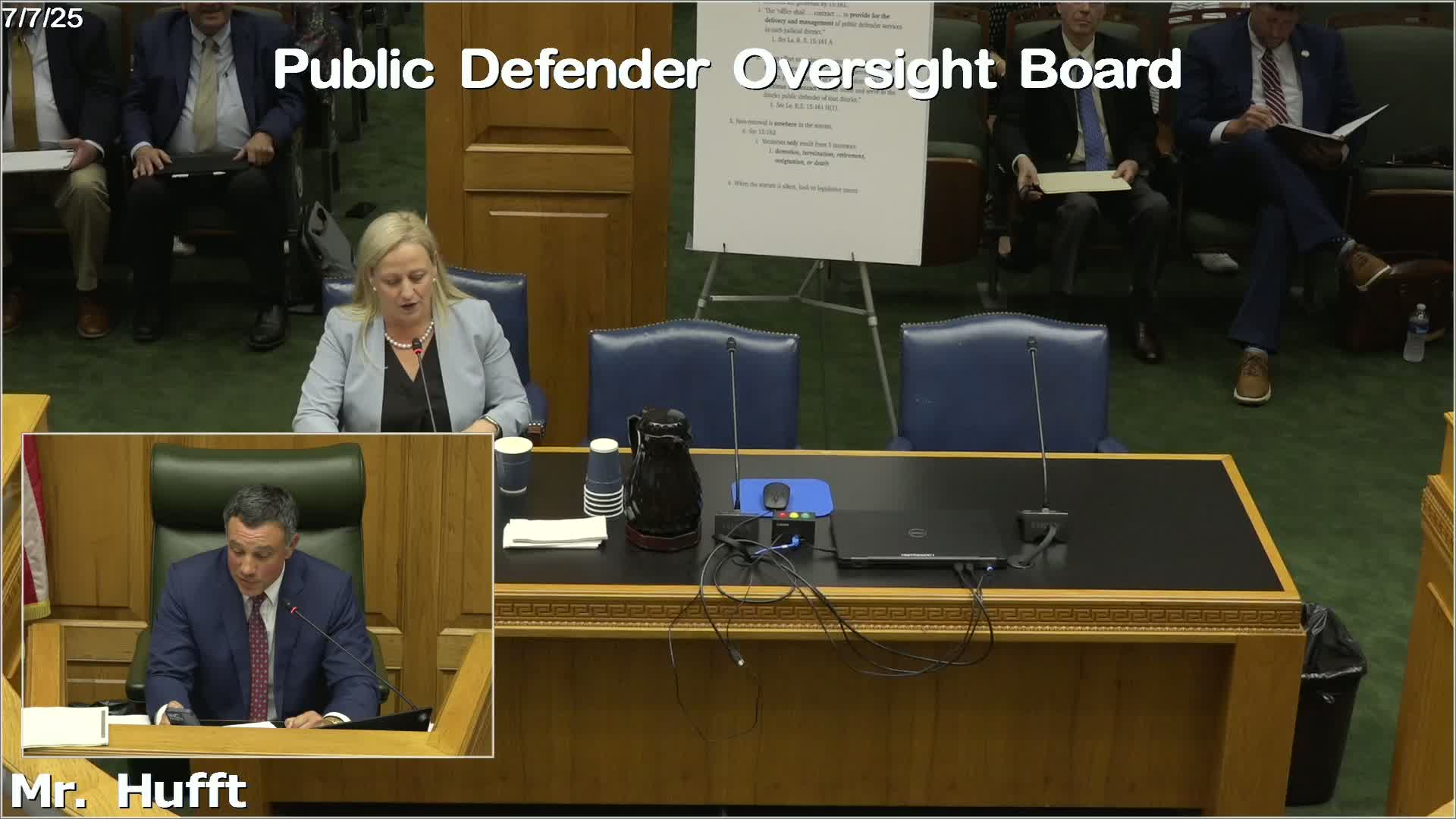
Summary
On July 7, 2025, the Louisiana Public Defender Oversight Board voted to adopt the April 7 hearing committee report and thereby maintain the state public defender’s decisions not to renew certain district-defender contracts.
BATON ROUGE — On July 7, 2025, the Louisiana Public Defender Oversight Board voted to adopt the hearing committee report from April 7 and thereby maintain the state public defender’s decisions not to renew certain district public defender contracts, a move that drew sustained public comment from current and former district defenders, legal scholars and state officials.
Public defenders and outside experts told the board the statutory framework and recent legislative history require continuity of district leadership and that the nonrenewals undermine independence and long-term local programs. The attorney general’s office and counsel to Governor Jeff Landry told the board their reading of the statutes and the bill record supports the state public defender’s authority to let one-year contracts expire without a hearing.
The issue centered on how to read several provisions of the Revised Statutes governing public defense, including La. R.S. 15:146(B)(1) (board oversight), La. R.S. 15:161(h)(1) (continuity/contracting with district public defenders), La. R.S. 15:162 (vacancies) and La. R.S. 15:170 (remedies and hearings). The board considered competing interpretations of those provisions and legislative amendments enacted as Act 22 of the 2024 Second Extraordinary Session (Senate Bill 8).
During a public-comment period that lasted more than an hour, current and former district defenders and national defense advocates urged the board to reverse the state public defender’s nonrenewals and order reinstatement. Trisha Ward, a district defender since 2021, summarized the defenders’ statutory argument: “La. R.S. 15:146(B)(1) makes it clear that the board has the duty to provide supervision and oversight to the office of the state public defender,” and, she said, the statutory scheme “emphasized continuity and stability in the management of district offices.”
Other district defenders described local programs and services they said require continuity. John Hoag (spoke as a district defender), said continuity allowed his office to secure opioid settlement funds and to plan for potential private investments. Michelle Andre Paul told the board she and four colleagues collectively have nearly 115 years of public defense experience and asked the board to “reinstate us to our rightful positions retroactive to July 1 with back pay.” Jean Faria, a former state public defender, told the board she had never seen an involuntary nonrenewal without cause in prior decades of administration and warned that oversight is necessary to protect independence.
National and academic voices also appeared. Pamela Metzger, a law professor and expert on public defense independence, argued that structural independence is essential to the effective delivery of the constitutional right to counsel and pointed to litigation and settlements in other states where removal practices raised independence concerns.
State legal and executive-branch speakers presented the opposite reading. Tom Jones, director of the civil division in the Attorney General’s Office, described the AG opinion the office provided to the board and summarized its conclusion: “If the contract expires, it no longer exists. Somebody’s not being removed. Nobody’s being terminated. Nobody’s being fired. The contract just ran out.” He said the statutes governing hearings (La. R.S. 15:170) apply when a contract is terminated before its term for cause, not when a one-year fiscal contract simply is not renewed.
Christopher Walters, deputy executive counsel to the governor, urged the board to consult the record of Senate Bill 8 and Act 22, saying the committee discussions and bill author statements made clear the legislature intended to protect existing contracts for the 2024–25 fiscal year and to vest the state public defender with authority to contract for district defenders going forward. Walters said, “I was there and I was a part of the passage of Senate Bill 8,” and he read portions of the House committee record describing a voluntary one‑year renewal option that applied for the 2024–25 year.
After public comment, board member Medlock Harbison moved that the board adopt the April 7 hearing committee report and reject the committee’s later June 18 recommendation. Judge Mary Devereaux seconded the motion. Board members debated procedure and whether the committee’s supplemental recommendation (June 18) or the original report (April 7) should be the operative recommendation for a final board vote; the board took a substitute motion to affirm the June 18 recommendation and that substitute motion failed. The board then voted on the original motion and adopted the April 7 committee report, maintaining the state public defender’s determination that he has no obligation under the statutes to enter into new annual contracts with the five district defenders under review.
The meeting record shows lengthy public testimony and legal argument on both statutory interpretation and legislative intent; board members repeatedly questioned procedural posture and whether additional investigation was required before taking a final vote. The board chair said the vote adopted the April 7 findings as the board’s action and the meeting adjourned after the vote.
The decision leaves in place the state public defender’s actions as described in the hearing records. Board members and public speakers repeatedly said further litigation or appeals are possible; the board did not issue reinstatements or retroactive awards at the meeting.
The board scheduled no final reinstatement or remedial action at the meeting; members indicated they would post the next meeting date and follow routine public-notice requirements.