
Auditor General presses Arizona Department of Education on ESA risk‑based auditing; ADE cites staffing and tech plans
Get AI-powered insights, summaries, and transcripts
Subscribe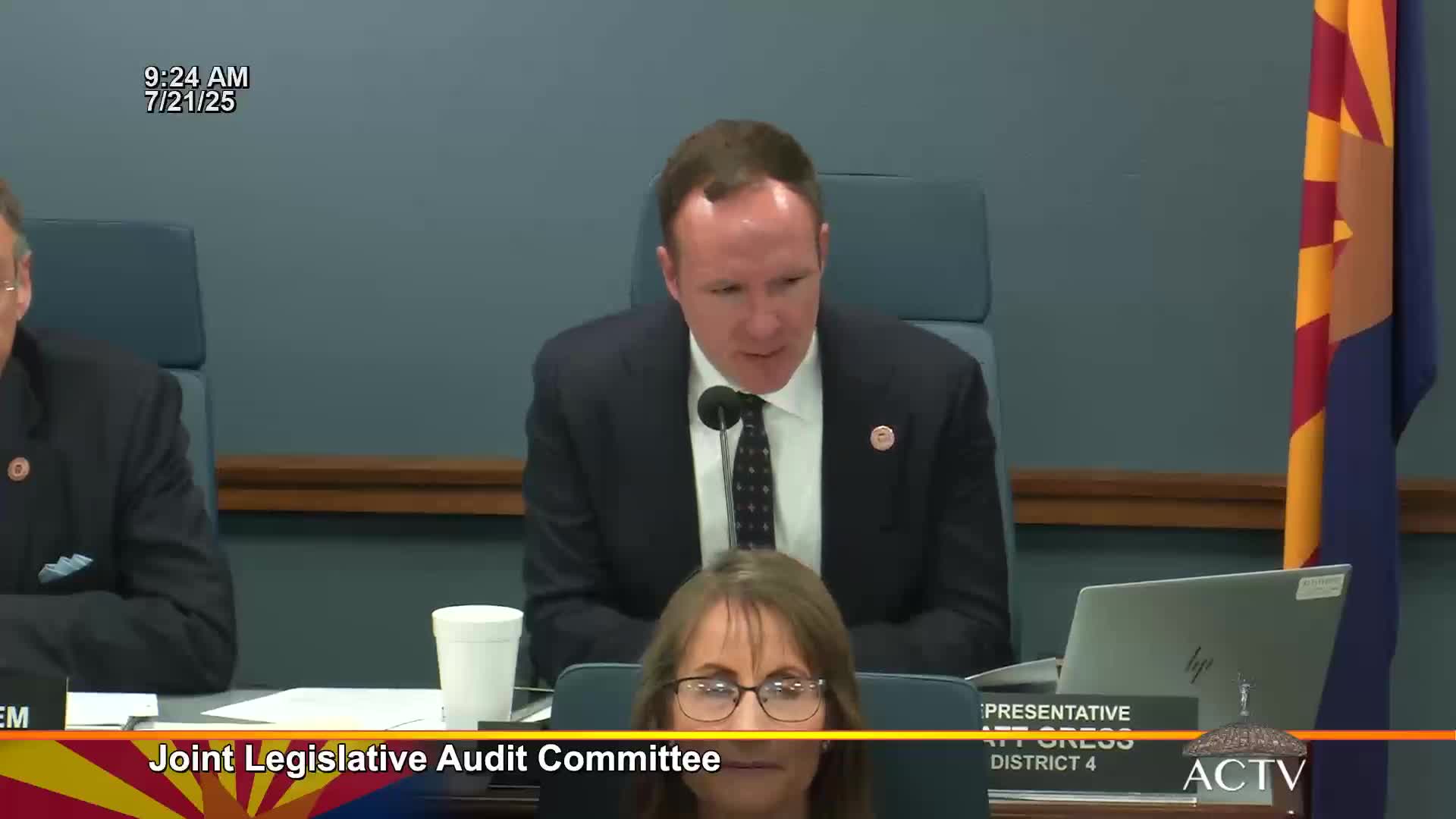
Summary
The Auditor General told lawmakers ADE has not yet completed statutorily required consultation to develop risk‑based auditing procedures for Arizona's Empowerment Scholarship Accounts; ADE said it has adopted a $2,000 review threshold and is pursuing automated, AI‑driven analytics with its vendor.
The Auditor General told the Joint Legislative Audit Committee that the Arizona Department of Education (ADE) has not yet completed the consultation required by statute to develop risk‑based auditing procedures for Empowerment Scholarship Accounts (ESAs), and urged ADE to meet with the Auditor General’s team to finalize procedures.
Lindsey Perry, the state Auditor General, told the committee that a law passed last session requires ADE to develop a risk‑based audit approach in consultation with the Auditor General’s office, and that the Auditor General had repeatedly requested such a consultation. "As of July 17," Perry said, "the department still has not met with my office to develop those risk based auditing procedures or in consultation with my office as required. Therefore, I'm providing this information to you, JLAC, and for consideration of formal direction to my office on how to proceed." Perry said her office remained available to consult and complete follow‑up work on prior ESA audits.
John Ward, director of the Empowerment Scholarship Account program at ADE, said the department has been in operational crisis because the program has grown quickly and ADE has limited staff. Ward said the ESA program has roughly 86,400 students enrolled with about 40 staff in the program and that ADE disbursed approximately $869 million in fiscal year 2025. He said ADE moved in December to a risk‑based approach that applies prospective review to purchases above $2,000 and risk‑based sampling for orders at or below $2,000. Ward described the $2,000 threshold as a practical step to keep purchase review queues from overwhelming a small staff while prospective reviews continue for larger orders.
Ward and committee members described ongoing efforts with the program’s financial vendor, Classwallet. Ward said ADE has been pressing Classwallet for a new anomalous‑activity reporting tool that uses artificial intelligence to flag suspicious patterns and identify specific transactions for review. "Using AI, they will be able to identify anomalous activity that would tip us off. We should probably take a look at this particular account and the spending associated with it," Ward said. He said Classwallet has developed similar functionality for other clients and ADE is pressing for an Arizona rollout.
Committee members pressed ADE about application and purchase processing times, account balances and funds that sit unused in ESA accounts. Ward said ADE can provide more granular reporting—such as fund balances by eligibility category and inactive accounts—and that the department would work with Classwallet to compile analytics for the committee.
Auditor General Perry and ADE agreed to a request from committee leadership to meet and to begin formal consultation. Committee Chair Finchem asked for a status update within two weeks on whether ADE and the Auditor General had conferred and how they plan to finalize the risk‑based procedures.
The committee also heard that ADE looks at many orders daily and that purchase reviewers check for misclassified items (for example, purchases labeled "tuition" that better fit another category) and for other potential misspending. ADE said some balances—money in ESA accounts for students not currently participating—become eligible for sweep only after statutory notice and waiting periods; ADE staff identified about $12 million available for immediate sweep linked to students who were found to be enrolled in public schools without resolving the eligibility question.
The committee directed ADE and the Auditor General’s office to coordinate on next steps and to report back to the committee as the consultation and implementation process moves forward.