
Southborough committee presses state agencies for funding options to build municipal wastewater system
Get AI-powered insights, summaries, and transcripts
Subscribe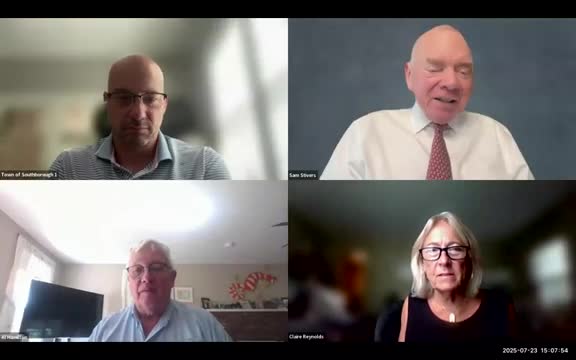
Summary
Town of Southborough officials and state representatives met Jan. 23 to review feasibility work and press state and trust staff for possible funding and timeline options to support a new wastewater system along Route 9.
The Town of Southborough Wastewater Study Committee met virtually Jan. 23 with state and regional officials to review work to date and to press for funding options to build municipal wastewater capacity along the Route 9 corridor.
The committee’s chair, Sam Sivers, said the town faces “a local tax revenue problem. We don't have enough commercial tax revenue in town,” and argued that municipal wastewater capacity is “a key to unlock this development potential.” The meeting included representatives from the office of state Sen. Eldridge, the Massachusetts Department of Environmental Protection (MassDEP), the Massachusetts Clean Water Trust, and the MWRA Wastewater Advisory Committee.
The committee and presenters summarized recent work and constraints. Al Hamilton, a select board member and former committee chair, said Southborough currently has no municipal wastewater system and that “building we have, we do believe that it is possible to build a wastewater plant and groundwater discharge. It's technically feasible, and we have identified several sites.” Hamilton gave the committee’s preliminary capacity estimate for full Route 9 buildout at roughly 300,000 to 500,000 gallons per day and repeated the committee’s central problem: paying for the project’s upfront costs.
MassDEP staff described the State Revolving Fund (SRF) process and eligibility. Mary Jude Peeksley, regional director for MassDEP’s Central Region, said SRF eligibility would cover both collection systems and treatment plants and noted the agency’s open project solicitation and Intended Use Plan (IUP) calendar. Nate Keenan of the Massachusetts Clean Water Trust outlined typical repayment timing for SRF loans: “Traditionally, the loans do go into repayment, about 2 and a half to 3 years after they appear in an intended use plan,” and said the Trust can work with towns on structuring repayments but expects a repayment stream because it is a revolving fund.
Trust staff also described loan terms the committee should expect in the Trust/SRF pipeline: a subsidized loan product (presented in the meeting as a 2% loan with an administrative fee and typical terms of 20 years, with the ability to extend to 30 years at an adjusted rate). Clean Water Trust and MassDEP staff offered to help the town with project submittal and permitting steps once the town has more detailed project designs.
Committee members and state staff discussed other financing approaches. Participants raised developer-driven revenue (tax revenue from new commercial development), district models used in other towns, and lessons from Cape Cod sewer projects that benefited from a state subsidy tied to short-term rental taxes. Committee members emphasized that going to a town meeting to borrow would likely require a two-thirds vote and would expose residents to multi-year debt service; Sam Sivers warned that recent local votes rejecting high-cost school projects would make asking town meeting for multi-million-dollar debt service “a really steep hill to climb.”
Representatives from the MWRA and neighboring towns described practical constraints on connecting to regional systems. Multiple speakers said a direct MWRA connection or relying on neighboring Westborough’s system appeared unlikely except for limited border properties, and speakers noted capacity and conveyance constraints at Deer Island as barriers to sending large new flows to MWRA treatment.
The committee said it has applied for a technical/design grant through a one-stop program; if funded, the design work would be used to pursue SRF loans or other financing. The committee reiterated interest in investigating a development impact/district approach and in talking with other Massachusetts communities that recently financed large sewer builds; MassDEP and the Clean Water Trust offered to provide contacts and examples such as Cape Cod towns and Orleans.
As a procedural matter at the meeting’s close, the committee voted by roll call to enter executive session to consider a purchase of property under the Open Meeting Law exemption for real estate negotiations; the motion was approved and the committee proceeded into executive session.
The committee said it will follow up with the state agencies and with several town and regional contacts to pursue design funding, refine cost estimates and repayment structures, and explore models other communities have used to bootstrap large sewer projects.