
Guam airport authority details concession expirations, urges coordinated rules after Public Law 38‑21
Get AI-powered insights, summaries, and transcripts
Subscribe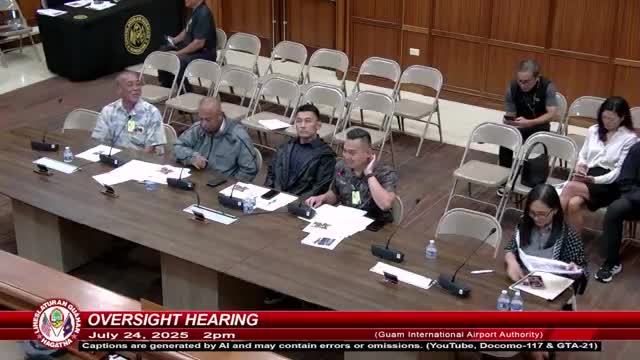
Summary
Guam International Airport Authority staff told a Senate oversight committee that several major concession and lease contracts expire in 2026, outlined available land and terminal space for development, and urged alignment of agency rules with an expected gubernatorial executive order implementing Public Law 38‑21.
Guam International Airport Authority officials told a Senate oversight hearing on Oct. 12 that the airport has more than 200 acres of developable land and about 500,000 square feet of rentable terminal space, and that several major concession and lease contracts expire in 2026.
Deputy Executive Manager Joe Mann told the Senate committee the airport’s terminal contains about 80,000 square feet dedicated to concessions — retail, food and beverage, car rentals and currency exchange — and that non‑aeronautical revenue from concessions and leasing has historically accounted for “anywhere between 20 to 35% of revenues,” depending on the year. “Their contract does currently expire on 07/20/2026,” Mann said of Lotte Duty Free when clarifying reports that the operator was leaving the airport. He added that food and beverage contracts (11 operators) and most rental‑car concessions expire on 08/31/2026, and that a parking concession expires on 10/31/2026.
Mann said the airport has received interest for aeronautical development including hangars, fixed base operators, cargo warehousing, in‑flight catering, fueling, flight training and maintenance, repair and overhaul (MRO) facilities. Mann said airport leasing and development must align with the airport layout plan that is part of the master plan and which is approved in coordination with the Federal Aviation Administration.
Committee members pressed airport officials on whether the authority or staff have been in contact with prospective bidders; Mann answered, “Not to our knowledge,” and said there are no solicitation or RFPs outstanding at this time. He described the current drafting of policies and procedures as an “iterative process” with the governor’s office and said final agency rules cannot be completed until the governor’s executive order that was referenced in a gubernatorial letter is issued.
Senator Kumatau, the committee chair, told airport staff that because the Legislature’s committee is working on amendments to Public Law 38‑21 the authority should “await the EO,” suggesting agency rules not be finalized until after the executive order is issued so the measures align. Mann and other airport staff agreed they were coordinating with the governor’s office and legislative staff to ensure transparency and competitiveness in forthcoming solicitations.
Senator Mittal and other committee members asked about the revenue potential of long‑term leases and larger infrastructure projects. Mann and other airport officials said large projects such as cargo facilities, hangars or an MRO could attract investment in the range of what the airport has previously discussed — “anywhere from, you know, a 100 to $300,000,000” — and generate broader economic activity even when some revenue is captured through land leases rather than airport commercial leases.
Committee members and airport officials discussed the impact of COVID on concession economics and industry practices. Mann said industry norms have shifted toward longer concession terms and different commercial constructs — moving from short, 10‑year terms to “closer to industry standard” 15‑year arrangements in some markets — and from strict minimum guarantees to percentage‑of‑sales structures and varied capital‑improvement timing.
Officials also described practical questions around expiring contracts: some operators are preparing exit plans and demobilization because their contracts have set end dates, and staff said an exit plan is a prudent commercial step even if an operator later pursues a new concession. Mann said the airport will evaluate financial capability, insurance and alignment with the airport layout plan when assessing prospective long‑term lessees.
Senators and airport officials stressed the need for a single point of contact for solicitations once they are issued, and for close coordination among the airport authority, the governor’s office and the Guam Visitors Bureau to avoid legal disputes. Mann noted the authority has previously extended certain contracts with legislative approval to allow capital improvements; he cited a Gucci presence as an example of recent specialty retail investment under such arrangements.
No formal votes or motions were recorded during the hearing segment reviewed. Committee members requested continued oversight and said written testimony would be accepted for seven days following the hearing.
The hearing record shows the committee and airport authority are actively coordinating rule drafting, federal funding alignment and procurement approaches while several major concession and lease expirations approach in 2026. The authority described available terminal and land capacity and said it hopes the combination of longer terms and land leases will attract large‑scale investment and support Guam’s broader economic recovery.