
Guam committee hears bill to let police hire in-house attorney; attorney general warns of constitutional risk
Get AI-powered insights, summaries, and transcripts
Subscribe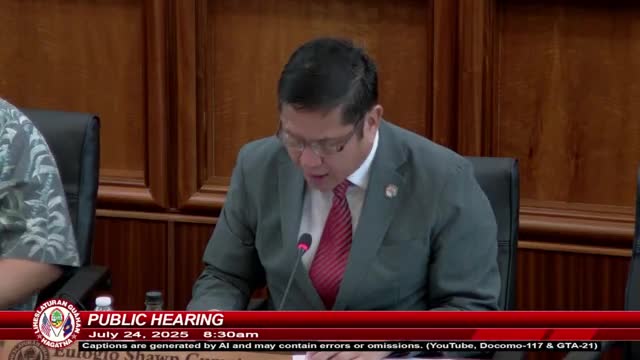
Summary
Hagatna, Guam — The Guam Legislature’s Committee on Public Safety, Emergency Management and Guam National Guard held a public hearing July 24 on Bill 158‑38 COR, a measure that would add a new subsection to chapter 77, title 10 and repeal a provision of Public Law 30‑202 to authorize the Guam Police Department to hire its own attorney.
Hagatna, Guam — The Guam Legislature’s Committee on Public Safety, Emergency Management and Guam National Guard held a public hearing July 24 on Bill 158-38 COR, a measure that would add a new subsection to chapter 77, title 10 and repeal a provision of Public Law 30-202 to authorize the Guam Police Department (GPD) to hire its own attorney.
The issue drew sharp contrast between the Guam Police Department and the Office of the Attorney General. Steven C. Ignacio, chief of police, urged restoration of GPD’s prior authority and cited delays and operational gaps; Attorney General Douglas Moylan called the bill “patently unconstitutional” and said allowing departments to hire private attorneys would erode prosecutorial authority and increase costs, though Moylan offered to recruit an attorney dedicated to GPD if the legislature funds the position.
BBMR fiscal note, GPD estimate
The Bureau of Budget and Management Research provided a fiscal note dated July 14, 2025, saying the proposed legislation would permit GPD to employ its own attorney but that no funding source is identified. The Guam Police Department supplied an estimated implementation cost of $186,263.16, composed of $124,244 in personnel costs and $62,020 in operational costs including office equipment, space and a vehicle, according to testimony by Ignacio.
Why it matters
The debate centered on two competing concerns: (1) timely, mission-specific legal advice for police operations — including evidence clearance, FOIA responses, policy review and other civil matters — and (2) constitutional and prosecutorial authority vested in the elected attorney general. Moylan argued the attorney general’s elected status gives the office unique prosecutorial powers and centralized legal policy that would be undermined if departments retained their own counsel. Ignacio and supporters said day‑to‑day policing increasingly requires immediate legal guidance the AG’s centralized office has not consistently provided.
What speakers said
Attorney General Douglas Moylan said voters elect the AG to “protect the people’s legal interest” and warned that allowing departments to hire private attorneys would fragment legal policy and increase litigation costs. “Bill 158‑38 is patently unconstitutional,” Moylan said, adding he would file suit if it passed. He also said his office is recruiting and has increased prosecutors since taking office in 2023 and that, if the legislature provides funding, he will assign or recruit a dedicated attorney to work with GPD under the AG’s supervision.
Chief Steven C. Ignacio testified in strong support of Bill 158‑38 COR, saying the department once had in‑house counsel and that its removal by prior law left “critical gaps in access to timely mission specific legal guidance.” Ignacio provided a workload summary for the department’s legal affairs section (testimony listed requests and case counts) and asked the committee to restore authority to hire in‑house counsel.
Senators pressed both officials on operational impacts and funding. Senator Sabrina Salas Mattanani asked for specific examples of investigations affected by legal delays; Ignacio described longstanding obstacles to clearing evidence and an effort to move an evidence control section to a new facility in Jigo that has been slowed by the need for AG sign‑offs. Several senators — including Christopher Duenas and others — emphasized the need to find a practical solution and suggested an MOU or a funded position assigned by the AG as a near‑term fix.
Alternatives discussed
Moylan and multiple senators described short‑term alternatives: the AG’s office could recruit an attorney to be detailed to GPD under a memorandum of understanding if the legislature appropriates funds. Moylan said that is preferable to multiple agencies hiring separate private counsel because salaried assistant AGs can be assigned across conflicts and lower total costs compared with hourly contract attorneys.
Committee action and next steps
The committee announced it will accept written testimony on Bill 158‑38 COR through July 31, 2025, and tentatively scheduled a markup for Monday, August 4, 2025, at 10 a.m. at the author’s legislative office. No vote on the bill occurred at the July 24 hearing.
Closing
Committee members said they will use the markup to refine statutory language and funding options and to weigh the AG’s constitutional concerns against operational needs raised by GPD. The committee encouraged written input from other agencies and stakeholders before the scheduled markup.