
Council affirms 10-year tax abatement and PILOT payments for hotel on Ball State land
Get AI-powered insights, summaries, and transcripts
Subscribe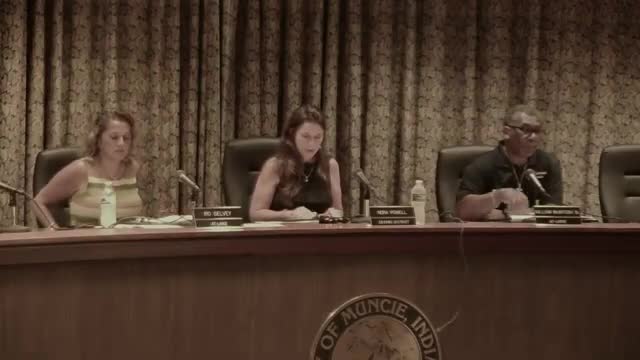
Summary
The Muncie Common Council confirmed a 10-year tax abatement agreement for a hotel being built on Ball State University land, approving a payments-in-lieu-of-taxes schedule and directing annual compliance reports on jobs and investment.
The Muncie Common Council on July 7 confirmed a 10-year tax abatement and payments-in-lieu-of-taxes (PILOT) agreement for a hotel project on Ball State University land, approving Resolution 14-25 after a committee review and public comment.
The agreement allows Muncie Hotel Partners to make annual PILOT payments to the city instead of property tax while the hotel stabilizes. Matt Anger, an attorney with Ice Miller LLP representing Muncie Hotel Partners, said the pilot payment schedule is $50,000 per year in years 1–5 and $100,000 per year in years 6–10 and described the request as “more cleanup” to align the abatement with a previously authorized pilot agreement.
The council and tax abatement committee reviewed the project’s statement of benefits, which lists a capital investment of about $43,000,000 and projects 50 new employees with estimated annual compensation of about $1,250,000. At the council meeting Anger provided an updated staffing split: about 65% of the 50 projected positions are expected to be full-time and 35% part-time, and he said full-time employees “should be benefit eligible.”
Why it matters: the parcel was previously owned by Ball State and not on the tax rolls because Ball State is tax-exempt. The abatement converts an exempt parcel into a taxable development once the abatement period ends and the property is placed on the rolls, while providing the city near-term PILOT revenue and later property tax if the hotel endures.
Committee review and public comment: the tax abatement committee met in advance of the council hearing and gave a favorable recommendation to report to the full council. Committee members and public speakers pressed the developer on local hiring and workforce details. Anger said the developer had held a workshop inviting local and minority-owned businesses and that annual compliance filings will be submitted to the city and council during the 10-year abatement to show hiring, compensation and capital commitments. A member of Muncie Community Schools, Dr. Chuck Reynolds, was quoted in the record supporting the project.
Concerns and limitations: several council members and public commenters asked whether the developer will adopt a local hiring goal, whether work will go to local or union contractors, and what wages and benefits will be offered. Anger said the developer had not finalized wage or benefit specifics and that the project team would follow up on construction-phase hires and workforce makeup. A critic at public comment called for denying the abatement because he said the project began before required filings were completed.
Formal action: the tax abatement committee voted to recommend approval to the full council. At the council meeting a motion to adopt the confirming resolution was made and seconded; the record shows the council adopted Resolution 14-25, confirming the economic revitalization area designation and approving the PILOT arrangement.
Next steps: the developer must file annual compliance reports tied to the statement of benefits during the 10-year period. If the hotel stabilizes after the abatement, the property will revert to standard property taxation and the tax receipts will be distributed among taxing units as usual.
Details omitted or not yet decided: the developer had not finalized wage rates, specific benefit plan names, or a formal local-hire or union agreement at the time of the hearing. Council members requested follow-up information on construction-phase contractor makeup and an hourly wage breakdown before the council’s final consideration and implementation work continues.