
Simsbury staff introduces draft dark‑sky lighting regulations; work session set for September
Get AI-powered insights, summaries, and transcripts
Subscribe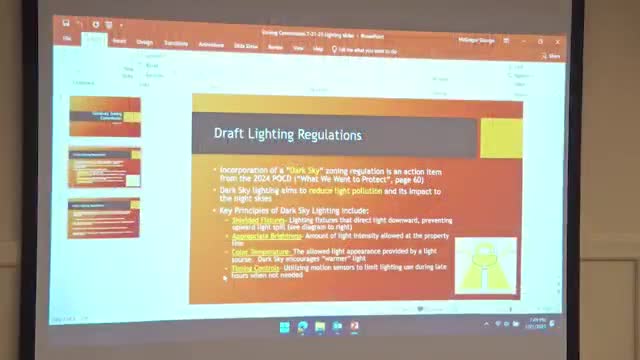
Summary
Planning staff introduced a draft lighting regulation to add dark‑sky standards—shielded fixtures, brightness limits, color‑temperature guidance and timing controls—to Simsbury's zoning codes.
Planning staff introduced a draft lighting regulation intended to incorporate dark‑sky principles into Simsbury's zoning codes and form‑based center codes. The draft aims to reduce light pollution, encourage shielded fixtures, set limits on brightness at property lines and establish color‑temperature and timing controls for new development.
"Dark sky lighting aims to, among many things, reduce light pollution and its impact to the night skies as well as reducing energy use," planning staff member Britney told the commission. Staff said the draft implements several familiar dark‑sky measures: fully shielded fixtures, photometric limits measured in foot‑candles at property lines, lower correlated color temperature for exterior fixtures, and timing controls such as motion sensors or curfews for nonessential lighting.
Why it matters
Commissioners and staff framed the draft as an implementation item from the town's 2024 Plan of Conservation and Development (POCD). The regulation would create consistent expectations for developers and permit reviewers, reduce unnecessary uplight and glare, and standardize how the town evaluates photometric plans submitted with site plans.
Scope and exemptions
Staff said the draft would apply to new site plans and site‑plan amendments that change lighting; it would not retroactively force homeowners to change existing residential fixtures. Street lighting for future subdivisions and lighting for new residential developments would be subject to the rules at the time of site plan or subdivision approval. Staff said the town would likely use outreach and education rather than enforcement to encourage voluntary residential compliance.
Concerns and next steps
Commissioners asked about enforcement difficulty, costs and potential pushback from developers who weigh lighting as part of safety and branding. Staff said many compliant fixtures are widely available and that the department will gather cost and vendor information, consult with other towns and schedule a work session in September. A public hearing is anticipated after further refinement, with staff planning outreach to the Chamber of Commerce, Main Street and local developers.
Planning staff also noted that draft rules do not yet apply to signage and said that fixtures already in place generally become legal nonconforming if the regulation is adopted; modifications that change fixture height or illumination would require a site‑plan amendment.
Ending
The commission directed staff to hold a work session on the draft in September and to follow with a public hearing in October after additional outreach and refinement.