Get Full Government Meeting Transcripts, Videos, & Alerts Forever!
Get email alerts on the Poplar Street Pedestrian Bridge topic
No spam. Unsubscribe anytime.
Casper unveils design and funding plan for Poplar Street pedestrian bridge to carry utilities and trails
Summary
City staff and consultants presented an arch-style pedestrian bridge design for the Poplar Street crossing, outlined a $5.75 million funding package including a $3.5 million Wyoming outdoor recreation grant, and said the bridge would carry water and sewer lines and allow safer pedestrian passage.
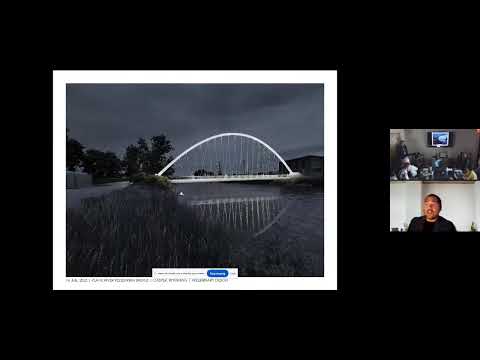
City staff and consultants presented the proposed design and funding plan for a new pedestrian bridge adjacent to the Poplar Street vehicular bridge at the council meeting on July 20. The proposed structure is a 20-foot-wide, single asymmetric arch with cable supports, seating/anchor blocks and lighting provisions intended to provide safe pedestrian access, event space, and a place to attach water and sewer lines currently hung from the Poplar Street bridge.
Tom Brower, project lead, said two earlier replacement attempts of the Poplar Street vehicular bridge had bid “grossly over budget,” and hanging utilities on that bridge had been estimated at more than $5,000,000 in earlier bid lettings. Brower said the city assembled a funding package that includes a $3,500,000 Wyoming outdoor recreation grant (ARPA leftover funds), roughly $2,000,000 in water funding, and about $250,000 in sewer funding, giving a current project budget of about $5,750,000.
Architect Max (presenting virtually) described an asymmetric tube-steel arch with crisscrossing cables intended to evoke mountain triangulation. Brower and others said the arch is both an aesthetic and functional choice: a free-span arch avoids mid-river supports, which would require contaminated-soil removal and expensive dewatering, and allows driven piles to reduce excavation.
Councilors asked about cost comparisons with other options. Staff said they had developed six design alternatives and selected the current option as the most cost-effective within the available right-of-way and grant timeline. Brower said the city is targeting use of the $3.5 million grant to maximize community benefit and would use the CMAR (construction manager at risk) process to refine cost estimates during schematic and later design phases.
Max and staff described lighting and event capabilities but cautioned that full decorative lighting may exceed current grant funding; staff said they would design electrical and conduit provisions so lighting fixtures can be added later if donors or future funds become available. Councilors asked about maintenance and lifespan; staff said the bridge is intended as a long-lived structure (Tom said he aimed for a “100-year bridge” and that the arch would require periodic recoating) and that the city would plan for long-term maintenance and possible fundraising for lighting and coatings.
Staff noted a time constraint for the grant funds: the $3.5 million “use it or lose it” deadline requires spending by the end of the next calendar year, so the project timeline is aggressive. Brower said the preferred construction window is when river levels are low and indicated driven piles and abutment designs are intended to limit contaminated-soil excavation.