Get Full Government Meeting Transcripts, Videos, & Alerts Forever!
Get email alerts on the Behavioral Health Prp topic
No spam. Unsubscribe anytime.
Baltimore council committee probes rapid growth, fraud concerns in psychiatric rehabilitation programs
Summary
Baltimore City Council's Public Health and Environment Committee held an oversight hearing on psychiatric rehabilitation programs (PRPs), during which Maryland Department of Health officials described rapid growth in PRPs concentrated in parts of Baltimore and said the state has paused new Medicaid enrollments for certain behavioral service providers while it investigates licensing, billing and quality concerns.
Baltimore City Council's Public Health and Environment Committee held an oversight hearing on psychiatric rehabilitation programs (PRPs), during which Maryland Department of Health officials described rapid growth in PRPs concentrated in parts of Baltimore and said the state has paused new Medicaid enrollments for certain behavioral service providers while it investigates licensing, billing and quality concerns.
The pause on new Medicaid provider enrollment, which began in July and covers PRPs and several substance-use outpatient program types, followed departmental reviews that flagged clustering of provider sites in Baltimore, potential multiple-site billing by the same staff and a subset of Medicaid payments the department identified as retractable. Deputy Secretary Alyssa Lord told the committee the state is convening data and regulatory workgroups to refine licensure and oversight.
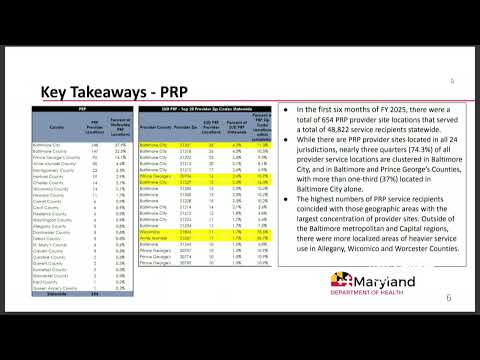
PRPs are community-based programs that provide rehabilitation and recovery supports, often billed monthly through Maryland's behavioral health administrative services organization (ASO). Officials said PRP growth has been especially heavy in Baltimore City: the department's geospatial analysis identified roughly 241 PRP sites in the city, about 35% of the statewide total, and indicated multiple PRP locations sometimes clustered on the same block.
"PRP or psychiatric rehabilitation programs are accreditation based ... programs that provide community based comprehensive rehabilitation and recovery services and supports and promote successful community integration and the use of community resources," Deputy Secretary Alyssa Lord said. Lord said state reviewers examined a subset of claims and "found that $600,000 in payments were retractable," and that those findings and community complaints prompted the CMS-approved moratorium on new Medicaid enrollments for the affected service lines.
Dan Rabbit, policy director at Behavioral Health System Baltimore (BHSB), described PRPs as part of a spectrum of supports for people with serious mental illness and outlined the local authority's role in contracting, complaint investigation and system management. "PRP creates the space and structure for meaningful life in the community," Rabbit said, and he emphasized that PRPs typically supply skills and supports that complement clinical treatment.
Council members pressed state and local officials on several points: how many PRP sites are run by the same operator versus new market entrants; how to measure program quality and outcomes; whether local communities have notice and input when PRPs open; and how proposed revisions to the Code of Maryland Regulations (COMAR) would change state oversight. Officials told the committee the draft COMAR revisions are intended to tighten staff, competency and accreditation expectations but have been paused for additional review after provider concerns were raised.
Community speakers at the hearing said clustering of PRPs has strained neighborhoods. Cecilia Gonzalez, executive director of Action Baybrook, said, "We have counted at least 32 PRPs in the Bay Brook area," and called for better geographic distribution, stricter regulation and stronger enforcement. Testimony from Yolanda Pulley and other community members praised small, locally rooted providers and urged emergency support and closer scrutiny of larger operators accused of fraudulent billing and weak community ties.
Witnesses described several oversight and quality-assurance tools that Maryland and local partners are pursuing or piloting: expanded clinical quality team reviews; consumer perception surveys run through the ASO; potentially standardized consumer feedback measures; and development of "fitness" criteria for licensure that could include staffing plans, competency assessments and financial sustainability reviews. BHSB and the Department of Health officials said they will expand data analysis on PRP utilization, cross-reference community need with provider density, and convene workgroups of providers, trade associations and local stakeholders.
Council members also asked about the role of local behavioral health authorities (LBHAs) in the licensure pathway. Dan Rabbit said current COMAR language makes an "agreement to cooperate" a largely paperwork-driven step and recommended strengthening requirements so LBHAs can require in-person community meetings and have clearer authority to flag providers for further review before licensure proceeds.
The committee did not take formal votes at the hearing. Speakers described next steps that include additional data extracts and geospatial analysis by the Maryland Department of Health, workgroup convenings to draft provider fitness criteria, and further oversight hearings at the city level this fall. Officials also reiterated how residents can report complaints: BHSB and the state licensing and compliance teams accept formal complaints through their websites and have escalation pathways to the Office of the Inspector General and the Medicaid fraud unit when investigations indicate criminal or systemic issues.
Local advocates asked the council to press for emergency relief for small community-based providers who say they followed rules and now face funding disruption as larger, allegedly fraudulent operators are investigated. State officials told the committee they will provide the council more detailed written materials on current COMAR requirements and on the data behind the enrollment pause.
The committee said it will continue oversight work and coordinate with state partners and with the mayor's office on legislative and regulatory remedies to strengthen quality standards, improve transparency for residents seeking care, and reduce the risk of fraud without unduly restricting access to needed services.
(For public guidance, witnesses named Carillon and other ASO vendors and cited COMAR 10.63 as the relevant set of statewide community behavioral health regulations.)
Ending: The council's Public Health and Environment Committee scheduled follow-up engagement: additional data sharing from the Maryland Department of Health; collaborative workgroups to develop licensure fitness criteria and consumer quality measures; and a planned fall convening of Baltimore behavioral health providers to pursue local quality standards and community integration. Residents with concerns about a specific PRP were told to file formal complaints with BHSB or the Maryland Department of Health.