
Planning commission reviews draft preservation overlay to allow traditional small-scale infill
Get AI-powered insights, summaries, and transcripts
Subscribe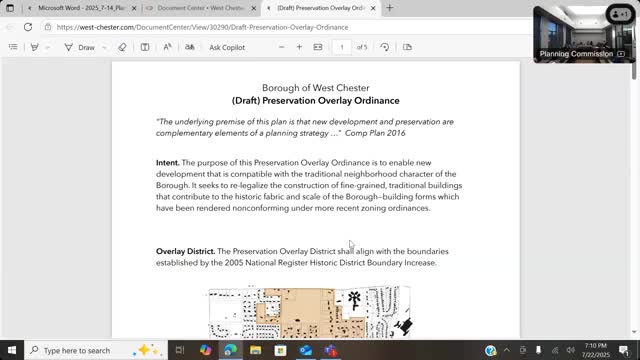
Summary
Commissioners reviewed a draft preservation overlay ordinance intended to permit narrow (14–20-foot) lots and traditional building forms in the National Register historic district boundary, with design standards for brick facades, aligned upper-floor windows and limits on height and impervious coverage.
The Westchester Borough Planning Commission discussed a draft "preservation overlay" ordinance designed to allow new, small-scale infill that matches the borough’s historic neighborhood fabric while imposing design standards to ensure durability and visual compatibility.
Commissioners said the overlay would let narrower lots (14–20 feet) and inner-block or alley-facing buildings if those structures meet preservation design standards: masonry walls, aligned upper‑floor openings, stoops, and museum- or alley-type right-of-way standards. The draft aligns the overlay with the 2005 National Register Historic District boundary and proposes a maximum height of three stories, building coverage up to 90% in some town-center standards, and impervious coverage limits tied to historic fabric goals.
Planner Alan Burke described the overlay as a tool to "re-legalize construction of fine grained traditional buildings" that are currently nonconforming under modern zoning. The draft allows lots to front a newly created "mews" right-of-way (minimum 18 feet, maximum 30 feet) and requires a minimum 5-foot paved stoop fronting lots, constructed of brick, stone or gravel. Parking rules in the draft require one off-street parking space per dwelling unit where a private right-of-way is created, and allow on-street spaces to count toward that requirement.
Commissioners raised technical and policy concerns. Members warned that tighter lot standards can raise construction and code-compliance costs, including fire-safety measures, sprinklers and minimum habitable-room sizes. Commissioner Steve Mitten noted higher-quality materials (for example, masonry walls and historically proportioned windows) increase durability but can make new units more expensive, complicating any affordable- or "attainable" housing aims. Several commissioners emphasized not conflating preservation design standards with an affordable-housing program: "The preservation design standards are not gonna make these houses cheaper," one commissioner said.
Next steps: commissioners asked staff to circulate a marked-up version, to meet with Smart Growth and with relevant borough professionals (fire marshal, code, tree commission) for technical review, and to produce a schedule that could lead to a code amendment before the end of the council’s current term if feasible. No ordinance text was adopted at the work session.