Get Full Government Meeting Transcripts, Videos, & Alerts Forever!
Get email alerts on the Airport Management topic
No spam. Unsubscribe anytime.
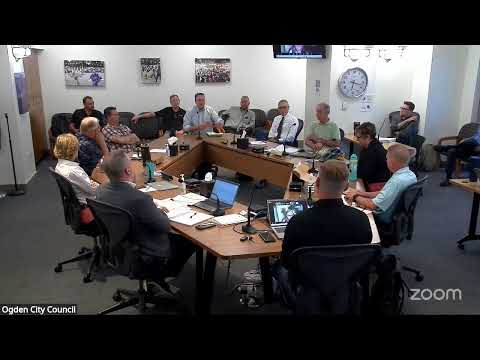
Ogden council and airport staff debate moving airport minimum standards from ordinance to administrative policy
Summary
City staff and aviation consultants urged updating 20-year-old airport rules to attract investment and commercial service; council members sought safeguards, staged transfer of authority and regular reporting. The council agreed to place a proposal on the Aug. 19 work-session agenda for consideration.
Ogden — City staff and outside aviation consultants told the Ogden City Council on July 22 that the airport’s 20-year-old minimum standards and related management documents need comprehensive updates to attract investment, support increasing passenger counts and prepare for emerging technologies.
The consultants said the council as the airport sponsor must set strategic direction, while day‑to‑day technical details should live in primary management documents that staff can update more quickly than municipal code. Council members said they supported updating standards but raised concerns about ceding too much legislative control without firm guardrails and regular reporting.
Why it matters: Minimum standards determine who may operate at the airport, what facilities and fuel storage are required, and how the city can attract airlines and private investment. Consultants and a potential investor said modern, clear standards are a prerequisite for hangar development, full‑service fixed base operators (FBOs) and new commercial routes — all of which city staff say could generate new revenue and jobs for northern Utah.
Consultants presented three practical drivers for change: (1) the need to modernize minimum standards that currently remain in Title 8, Chapter 4 of the municipal code; (2) industry changes — for example, the FAA and industry push toward unleaded avgas and the future emergence of vertiports/eVTOL — that require rapid response; and (3) investor interest that is conditional on clear, durable rules. Ryan, an airport consultant, summarized the governance point this way: "it's really the... elected officials of the sponsor that set the strategic vision and direction of the airport." That, he said, justifies the council setting policy while delegating technical adjustments to administration.
Key specifics discussed
- Passenger thresholds and federal funding: Consultants reminded the council that reaching 10,000 annual enplanements is a recognized threshold for certain federal entitlements. Ogden’s enplanements were described in the presentation as about 15,000, compared with Provo’s roughly 415,000; consultants said staying above thresholds improves eligibility for federal airport grants under the National Plan of Integrated Airport Systems (NPIAS).
- FBO standards and hangar development: Draft minimum standards in the consultants’ packet propose larger leasehold and structure minimums than the current code (examples discussed included 3–5 acre leaseholds and structure footprints in the tens of thousands of square feet). Door heights, apron area and dedicated aircraft storage were highlighted as examples of technical items that affect the ability of operators to bring larger business jets onsite.
- Fuel and operations: The consultants discussed fuel‑storage minimums and self‑fueling rules. They noted current practice at some airports to require FBOs to hold tens of thousands of gallons of jet fuel (jet A) and to treat avgas/unleaded avgas (100LL and emerging unleaded 94) differently. The consultants warned that federal grant assurances and evolving FAA guidance will influence what the city can require and how it must price non‑aeronautical uses of airport land.
- Emerging technology and regulation: The presentation covered advanced air mobility and vertiports, sustainable aviation fuel, and the FAA’s evolving advisory guidance; presenters said the city needs flexibility to respond quickly to opportunities and to qualify for state or FAA funding tied to new infrastructure (for example, charging and vertiport readiness).
Stakeholder views and investor signal
Garrett Hain, vice president of finance for Aflite (an FBO operator), told the council: "we feel that there's really an urgency to get moving on some of the improvements on the airport." Hain said Aflite invests where rules are clear and that the firm’s farther development at Ogden was conditional on updated minimum standards.
Council concerns and requested safeguards
Several council members voiced two recurring concerns: preserving legislative oversight and ensuring responsiveness. Members asked for (a) a clear skeleton of policy retained in the municipal code (definitions, enforcement and the council’s reserved powers), (b) a process for timely administrative updates when industry conditions change, and (c) regular reporting so the council remains informed. Councilmembers also asked staff to involve FBOs and other airport tenants in drafting final language and to return with a phased ordinance/policy plan rather than an all‑at‑once transfer.
Next steps and outcome
Staff and consultants proposed a staged approach: move definitional and enforcement language into ordinance, place technical operator requirements and FBO minimums in administrative policy, and require an annual status report to council. The council asked staff to place the draft package on the Aug. 19 work‑session agenda for consideration and possible action. City staff also agreed to continue stakeholder engagement with current FBOs and tenants prior to that meeting.
Quotes in context
- "It's really the... elected officials of the sponsor that set the strategic vision and direction of the airport," Ryan, airport consultant. - "We feel that there's really an urgency to get moving on some of the improvements on the airport," Garrett Hain, vice president of finance, Aflite (FBO operator).
Discussion vs. decision
The July 22 meeting produced discussion, direction and a scheduling decision: the council did not adopt new minimum standards on July 22 but agreed to consider the staff/consultant proposal at the Aug. 19 work session. Staff were directed to continue stakeholder engagement and to return with a recommended ordinance/policy split and an annual reporting plan.
Ending note
Staff emphasized that the changes are intended to modernize rules last updated in 2005, improve the airport’s competitiveness in northern Utah, and preserve the council’s policy role while allowing faster administrative responses to evolving aviation standards and investment opportunities.