Citizen Portal

DHS inspector general says ICE cannot reliably track hundreds of thousands of unaccompanied children released from federal custody

5456998 · July 24, 2025

Get AI-powered insights, summaries, and transcripts

Subscribe
AI-Generated Content: All content on this page was generated by AI to highlight key points from the meeting. For complete details and context, we recommend watching the full video. so we can fix them.

Summary

An audit by the Department of Homeland Security Office of Inspector General found significant data gaps and coordination failures after ICE transferred more than 448,000 unaccompanied alien children to HHS between FY2019–FY2023; the report cites missing contact information, unissued notices and thousands of children who failed to appear in court.

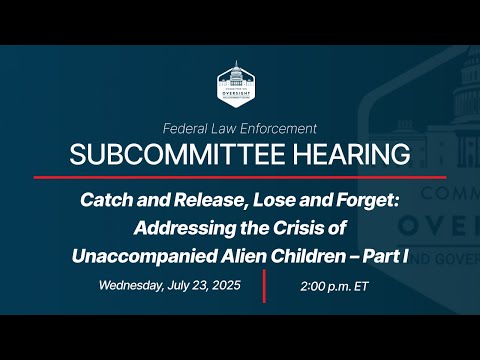
The Department of Homeland Security inspector general told a House Oversight subcommittee that his office’s audit found ICE cannot effectively monitor the locations and status of all unaccompanied alien children once they leave federal custody.

"Our audit revealed significant gaps in how ICE monitors and manages the cases of UACs once they're released from federal custody," Inspector General Joseph V. Kuffari said in opening remarks summarizing his office's report.

The audit, published in March and discussed at the hearing, covers fiscal years 2019 through 2023. The report states that ICE transferred more than 448,000 unaccompanied alien children to the Department of Health and Human Services during that period. Of that group, the audit found ICE did not issue more than 233,000 notices to appear in immigration court, more than 31,000 sponsor release addresses were blank or undeliverable, and more than 43,000 children who were served notices failed to appear for their scheduled court dates.

Why it matters: The subcommittee and the inspector general framed the gaps not simply as record-keeping problems but as risks to children and to public safety. Kuffari said the shortcomings "leave Children vulnerable [to] exploitation, trafficking, forced labor or involvement in criminal activities," and recommended changes to staffing, data sharing and interagency coordination.

Key findings and context

- Volume and staffing: Kuffari told members that, as of September 2024, ICE had just over 1,000 staff assigned to monitor more than 7.5 million non-detained cases, a scale he said the agency could not meaningfully monitor at an individual level.

- Records and vetting: The report cites a 2021 change in the memorandum of agreement between DHS and HHS that removed a prior requirement that HHS provide ICE with biographic and biometric information for potential sponsors and adult household members; the audit said that change constrained ICE’s ability to vet sponsors.

- Court process: Auditors found tens of thousands of missing or erroneous sponsor addresses and a large number of children who did not appear for immigration hearings after being issued notices to appear.

- Recommendations: Kuffari said his office made six recommendations to improve monitoring; he told the committee that ICE accepted all six.

Committee questions and responses

Members pressed Kuffari on whether his office had considered criminal referrals in connection with policy decisions or agency actions. Representative Scott Perry asked whether the OIG had ever considered referring the secretary or others for criminal investigation; Kuffari answered, "Not to my knowledge, Mr. Perry." Perry and other Republicans at the hearing suggested personnel or policy decisions contributed to a large population of children whose locations were uncertain.

Ranking Member Representative Lee criticized Kuffari's independence and noted a report by the Council of the Inspectors General on Integrity and Efficiency that raised concerns about his conduct. Lee also raised findings that the council had recommended discipline and alleged misuse of taxpayer funds for internal investigations; Kuffari disputed the characterizations and repeatedly answered that he understood what the council had written.

Other lawmakers urged site visits to detention facilities and raised alleged harms to children in custody, while supporters of the IG's report emphasized the risks of children entering informal sponsor networks without adequate vetting.

What the report does not say

The audit documents administrative and data shortcomings; Kuffari told the committee that the OIG does not have authority to prosecute criminal cases and that criminal referrals would be handled by the Department of Justice. The inspector general and members repeatedly distinguished policy decisions from individual criminal culpability, saying OIG can investigate departmental employees and contractors administratively and can conduct criminal investigations of staff but that DOJ decides prosecutions.

Ending note

Kuffari closed his opening remarks by saying the deficiencies are a systemic breakdown that "carries real risk to the children themselves, to the integrity of the immigration system, and to the public trust in our immigration system and law enforcement institutions." The subcommittee’s questioning ranged from technical queries about data sharing and vetting to partisan attacks on the inspector general’s record and independence; the hearing recessed for votes after several hours of testimony and questioning.