Get Full Government Meeting Transcripts, Videos, & Alerts Forever!
Get email alerts on the Eviction Prevention topic
No spam. Unsubscribe anytime.
Montgomery County honors Project Safe coalition after preventing more than 377 evictions in East County
Summary
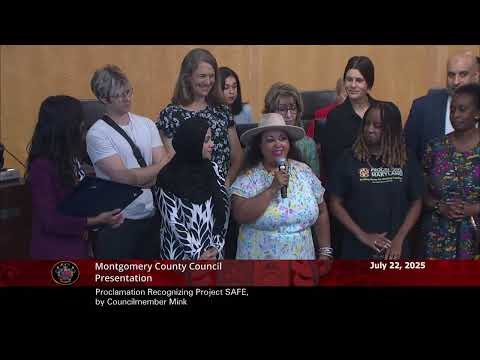
Councilmember Kristen Mink and county health and housing staff recognized a coalition of resettlement agencies, faith groups, tenant organizers and volunteers for a volunteer-led eviction prevention effort that county officials say prevented housing loss for at least 377 people, many of them refugees.
Councilmember Kristen Mink recognized a coalition of resettlement agencies, nonprofits, faith institutions and county staff on the East Side for an effort she said prevented eviction and preserved housing for at least 377 people. The proclamation presented July 2025 names Project Safe, the Muslim Community Center (MCC), the Islamic Society of the Washington Area (ISWAD), resettlement organizations and county Department of Health and Human Services staff.
The proclamation and remarks at the Montgomery County Council credited a partnership of volunteers, tenant associations and county case managers for coordinated outreach, rapid response and fundraising that the county said helped people avoid homelessness. "We have together helped to prevent the eviction and, and continue the housing for over 377 individuals," Councilmember Kristen Mink said.
Why it matters: County and community leaders said the work combined culturally and linguistically appropriate volunteer case management, short-term financial support and on-the-ground tenant organizing to keep people housed. County staff and resettlement agencies provided formal case management and used funding obtained at the county and state level, while volunteers and tenant associations provided rapid-response moving assistance and municipal navigation.
County and community roles and practices described at the ceremony included: Montgomery County Department of Health and Human Services (DHHS) Services to End and Prevent Homelessness (SEPH) providing intensive case management; resettlement agencies such as Lutheran Social Services and the International Rescue Committee coordinating placement; the Muslim Community Center raising funds and providing multilingual support; and grassroots groups like the Enclave Tenant Association organizing rapid-response teams on moving days. "They provided volunteer case management, including in Pashto, Dari, and Arabic," the proclamation reads.
Speakers who addressed the council included Kristen Mink, Councilmember for District 5; Tasniva Khan, executive director of Faith Alliance for Community Equity and Sustainability Inc.; Pascal LaMaire and Tania Chestnut of the Enclave Tenant Association; Sandra Marshall, social work supervisor with Silver Spring Housing Stabilization Services; Christine Hong, chief of Services to End and Prevent Homelessness (SEPH) at DHHS; Ilhan (Ilhan Kagri) and Ambreen Hussain of Project Safe; and many county case managers and volunteers. Several speakers described volunteer fundraising and in-kind support: Project Safe raised more than $10,000 via grassroots fundraising and MCC raised more than $200,000, and volunteers donated vehicles and time, according to remarks at the ceremony.
The council read a proclamation that thanks the coalition for preventing "well over 300 individuals" from being unhoused and notes the role of county staff, resettlement agencies, faith institutions and tenant organizers. Council President Kate Stewart joined Mink in signing the proclamation. No formal policy action or funding vote was taken at the event; council members and county staff discussed prior budget adjustments that had increased SEPH case-management capacity.
Community context and next steps: Speakers emphasized collaboration across government, resettlement agencies, faith groups and tenants' organizations and urged continued community support and funding. The council public acknowledgement does not itself create new county funding or a new program; county representatives said that funding had already been requested and approved in prior budget actions to expand case-management positions that supported the work.
Many speakers at the event were volunteers or county staff who described program and operational details; for example, Romana Gaddiso identified herself as a caseworker who said her position was created through a council-approved hire. Organizers urged community members to join rapid-response efforts and to continue supporting culturally competent services for refugee and immigrant households.