Get Full Government Meeting Transcripts, Videos, & Alerts Forever!
Get email alerts on the Environment Native Plants topic
No spam. Unsubscribe anytime.
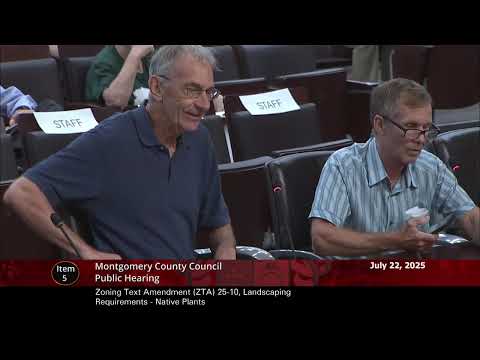
Residents, landscapers urge Montgomery County to require more native plants; ZTA 25‑10 hearing draws mixed input
Summary
At a July 22 public hearing, many residents and landscape professionals urged Montgomery County to adopt ZTA 25‑10 requiring 50 percent native plants in required landscaping, while some industry speakers warned of practical and economic challenges.
A public hearing on Zoning Text Amendment 25‑10, the county’s proposed native‑plant landscaping requirement, drew extensive testimony on July 22, 2025. The amendment would require that 50 percent of required landscaping consist of native plant species; a Planning, Housing and Parks committee work session will be scheduled later to consider details and possible refinements.
Why it matters: Supporters told the County Council that native plants provide critical habitat for insects and birds, improve stormwater retention and reduce maintenance and chemical use. Several speakers cited entomology research and outreach programs and urged the council to adopt a higher native‑share threshold and to tie the county’s native definition and species list to the Maryland Native Plant Program and the Maryland Plant Atlas.
What speakers said: Conservation groups and native‑plant professionals — including Chris Colby of Backyard Bounty, Zach Klein (ecological landscaper), Kit Gage (Friends of Sligo Creek), and representatives from Nature Forward and the Maryland Native Plant Society — urged the council to adopt the ZTA with amendments. Common requests included: using the Maryland native species list as the authoritative source; allowing cultivars or nativars in specific cases (but with limits, e.g., avoiding cultivars that alter leaf color); defining native composition by biomass, not merely species count; and including trees and shrubs (not just grasses) in the native calculation.
Landscape professionals testified both for and against the 50% requirement. Bernie Mimm, a licensed landscape architect and certified arborist, and representatives of local sod producers said some nonnative species and cultivars are necessary in urban or high‑stress conditions, cited pest pressures (emerald ash borer, chestnut blight, deer browsing) and raised sourcing, maintenance and cost concerns. Montgomery County Farm Bureau and local turf‑producers urged caution, warning of potential local economic impacts for sod farms.
Implementation and definitions: Multiple speakers urged using the Maryland Native Plant Program (the Maryland Plant Atlas and the program established in state law) as the county’s authoritative list to avoid ambiguity and ease sourcing. Several speakers emphasized the need for public education, nursery partnerships and phased implementation; Nature Forward requested clarifying language to count native biomass and to use the Maryland Invasive Species Council list for identifying prohibited invasives.
Next steps and deadlines: The public hearing was closed on July 22. The council will schedule a PHP committee work session to consider revisions and will accept written materials for the record through July 31, 2025, for council consideration. No legislative vote occurred at the hearing; the ZTA remains under committee review.