Get email alerts on the Gas Infrastructure topic
No spam. Unsubscribe anytime.
PUC sets hearing on Public Service Co. $572 million gas infrastructure plan, shields sensitive mapping data
Summary
The Colorado Public Utilities Commission set Public Service Company of Colorado's 2025–2030 gas infrastructure plan (GIP) for hearing, established intervenors, granted extraordinary protection for the company's system-mapping data and deferred additional testimony to a later date.
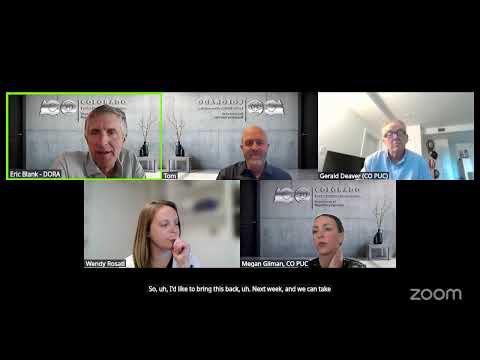
The Colorado Public Utilities Commission on July 23 voted to set for hearing an application from Public Service Company of Colorado to approve a multi-year gas infrastructure plan covering projects the company says are needed from 2025 through 2030. Commissioners also established parties to the case and granted the company’s motion for extraordinary protection to limit public access to detailed GIS mapping and underlying system data.
The commission’s action follows an application filed May 23 in which Public Service described a GIP containing 62 projects with an estimated $572,000,000 in capital expenditures. The filing asked the commission for approval under commission rule 4455, a presumption of prudence for planned projects and cost estimates, certificates of public convenience and necessity for two projects, and other relief.
The commission’s decision sets a formal hearing so the parties can litigate the merits. Commission counsel indicated the filing is supported by direct testimony from 13 witnesses. Commissioners instructed staff to prepare a minute-entry decision that will set the hearing, list the parties and grant the extraordinary-protection request; the commission did not order supplemental direct testimony at this meeting and will address any further directives at a future weekly meeting.
The filing identifies two projects for which the company requests a CPCN: the Lewisville-to-Rollins Pass project and the Spear Canal Interconnects project. According to the filing, the Lewisville-to-Rollins Pass project is intended to mitigate exposed pipe on a critical 10-inch supply line in the mountain area near Rollins Pass and is estimated at about $22,800,000. The Spear Canal Interconnects is described as five interrelated Front Range capacity and reliability upgrades, with an estimated total cost of about $42,700,000.
Commission counsel also summarized the list of intervention requests and recommended outcomes. The commission acknowledged interventions from commission staff, the Colorado Energy Office and the Office of the Utility Consumer Advocate and granted permissive interventions for the City and County of Denver; Colorado Communities for Climate Action; a coalition of conservation groups (including Natural Resources Defense Council, Sierra Club and others); and trade groups including the Colorado Association of Home Builders and Home Builders Association of Metro Denver. Two pro se filings—Justin Knowles and Christopher Pal Fellows—were treated as public comment and their intervention requests were denied because counsel found they did not meet the filing standards.
On the extraordinary-protection motion, the company asked the commission to protect an ArcGIS Online map and underlying infrastructure attributes it labeled “highly confidential,” including exact locations, pressures, piping details, age and material of distribution pipes, and other system attributes. Counsel recommended granting protection now so intervenors and commission advisory staff can receive timely access under controlled conditions; commissioners agreed and directed the company to coordinate with advisory staff on how to provide viewing access to authorized reviewers.
The commission explicitly distinguished discussion from formal action: it approved the minute-entry decision to set the matter for hearing, to establish parties as described, and to grant the mapping-data protection. The commission postponed decisions about who will preside over the hearing (a hearing commissioner or the full commission en banc) and whether to direct the company to file supplemental direct testimony until a later meeting. Counsel noted a final decision in the matter will be due in March and explained scheduling implications for an en banc hearing (likely in January) versus a hearing-commissioner schedule (likely in November).
Why it matters: the GIP would represent a major capital program for natural gas infrastructure in the region, and the commission’s decision to protect detailed mapping data responds to the company’s security concerns while allowing regulated intervenors and staff controlled access for the litigation. The hearing will test the prudence, need and cost recovery proposals in the filing.
The commission record indicates the hearing will include testimony and briefing from a variety of consumer, municipal, environmental and industry stakeholders; the order to set the case for hearing and the decision on access to mapping data were adopted by minute entry at this July 23 meeting.
Additional details: the company characterized most GIP projects as system-safety-and-integrity work; the filing compares the $572 million in GIP projects to an approximate company spending forecast of roughly $570 million per year for 2025–2029, and staff noted the GIP sum represents about 20% of the company’s forecasted expenditures over that planning horizon. Commissioners asked counsel and staff to return with a separate decision that would set out any additional directions, including whether to require supplemental testimony and to designate who will preside over the proceeding.
Speakers quoted or paraphrased in this story appear in the speakers listing below.
AI generated
The text on this page is AI generated. Summaries, highlights, analysis, and video transcripts are all produced from the original source material.
AI can make mistakes, so if you spot one, and we will fix it for everyone.
Note: the source content is unaltered by us. Any content source we link to, be it a video, an audio recording, or a document, is presented exactly as its publisher released it. That publisher is usually a government body, sometimes an individual official or another organisation.