Get Full Government Meeting Transcripts, Videos, & Alerts Forever!
Get email alerts on the Transportation Data Program Implementation topic
No spam. Unsubscribe anytime.
CTC staff recommends hybrid model to expand access to transportation data under AB 744
Summary
California Transportation Commission staff proposed a hybrid approach combining competitive grants and centralized procurement to implement Assembly Bill 744, aiming to broaden agency access to travel and safety data while addressing technical capacity and funding gaps.
California Transportation Commission staff recommended a hybrid implementation that combines competitive funding and centralized procurement to carry out Assembly Bill 744 during a public workshop on the AB 744 Transportation Data Program.
The recommendation would pair a competitive grant program that lets agencies procure tools tailored to local needs with a centralized state purchasing approach to secure software licenses and allocate access to state, regional and local agencies. "The hybrid approach balances local autonomy with state level coordination and purchasing power," Sheila Innes, transportation data program manager for AB 744 at the commission, said during the workshop.
The staff presentation summarized findings from stakeholder engagement that informed the recommendation. Engagement included virtual meetings, surveys and prior workshops and solicited input from metropolitan planning organizations, regional transportation planning agencies, congestion management and self-help counties, vendors, other state departments and members of a housing-and-transportation subcommittee. Ken Lopez, research data specialist for the Trade Corridor Enhancement Program, said the workshops were offered in hybrid and fully virtual formats "to allow our stakeholders the opportunity to participate more fully no matter where you're at."
Staff identified recurring challenges that might hinder implementation: limited technical expertise and staff capacity at local agencies, insufficient funding and wide disparities in available funding between jurisdictions. The most commonly reported analytic outputs were travel time, vehicle miles traveled and safety. The top planning tools stakeholders reported using were Replica, ArcGIS and INRIX; other tools named included StreetLight, RITIS, Streetsaver, Locus, PEMS, Placer AI, Teralytics and the National Performance Management Research Dataset. The primary modeling packages cited were Bentley Cube, Caliper TransCAD and EMI.
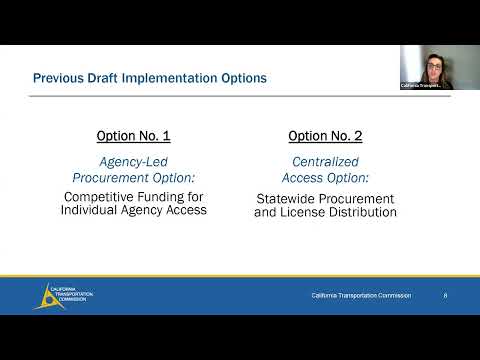
The commission staff described three draft implementation options presented during the engagement: (1) an agency-led procurement model in which state-administered competitive funding would allow individual or consortium applications for tool procurement; (2) a centralized access model in which a state agency would purchase software licenses in coordination with the Department of General Services and allocate access to agencies; and (3) a hybrid combining competitive funding with centralized procurement. Staff recommended the hybrid model, citing stakeholder support for both local flexibility and state purchasing power.
Matthew Yoscott, deputy director for SB 7/SB 1 programs, said the hybrid recommendation reflected public comments received during the formal comment period and previous workshops. "We are very comfortable and confident moving forward with this hybrid approach in our proposal to the Legislature," he said.
No formal vote occurred at the workshop. Staff laid out next steps and a schedule: the final proposal was to be posted on the commission's website on Aug. 1, presented at the August commission meeting for approval and, if advanced, submitted to the Legislature in September. Staff noted they would continue to monitor the legislative process and work with legislative partners on whether to advance a funded program.
Workshop presenters said written feedback submitted during the 30-day comment period, which opened after the June 13 draft posting and concluded July 13, informed the recommended approach. Comment letters came from multiple metropolitan planning organizations, regional transportation planning agencies, the California Association of Councils of Governments and a member of the Rural Counties Task Force; common themes included support for the hybrid option, requests to prioritize foundational and widely used tools, and encouragement for interagency collaboration and peer learning.
Participants were invited to provide additional input; when staff asked for questions or comments during the session, none were raised. Staff reiterated that further implementation details—such as program guidelines, funding allocations and procurement mechanics—would be developed if the proposal advances through the Legislature. The commission's posted materials and staff contact information remain the primary channels for follow-up.