Get Full Government Meeting Transcripts, Videos, & Alerts Forever!
Get email alerts on the Water Recharge topic
No spam. Unsubscribe anytime.
Cochise flood district approves $300,000 land purchase for Bisbee effluent recharge project over one dissent
Summary
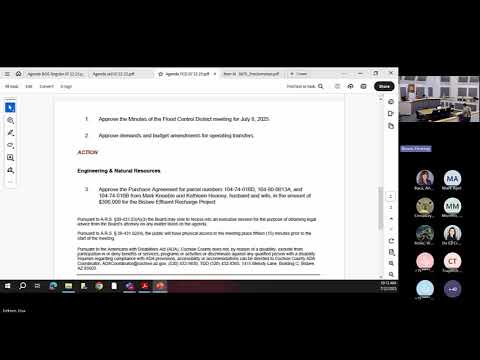
The Cochise County Flood Control District approved a $300,000 purchase of parcels intended for the Bisbee effluent recharge project, 2-1, after public testimony both supporting and opposing the project and a failed attempt to table the purchase for further review.
At a Flood Control District meeting in Bisbee, the Cochise County Board of Supervisors voted 2–1 to approve a $300,000 purchase agreement for two parcels intended for the Bisbee effluent recharge project.
The vote authorizes purchase of parcel numbers 10474101D104-80-0013A and 10474010B for the listed sellers, identified on the agenda as Mark Nabel and Kathleen Haines, husband and wife. The board approved the purchase after public testimony that included both endorsements and concerns about water quality and long‑term effects on downstream wells.
The purchase is intended to secure a location for recharging treated effluent into the San Pedro River as part of the Bisbee effluent recharge project. "We know from over 25 years of monitoring that groundwater and surface water flows in this segment of the river have been declining severely due to drought and pumping in Mexico," said Mark Appel, who described his previous role as the county's environmental projects coordinator and spoke on behalf of the Cochise Conservation and Recharge Network. Appel told supervisors that delaying the acquisition could jeopardize the landowner's willingness to sell and the work invested by project partners.
Steve Pauken, city manager for the City of Bisbee, told the board the city "is all in, on this" project and noted the city has negotiated intergovernmental agreements to supply effluent and has "secured a $2,000,000 WIPA grant" to locate a pump house near the city's outfall to help move water toward the recharge site.
Opponents warned of potential contamination risks. "Please do not approve this project ... it's full of PFASs, and that is, that's forever chemicals that will kill people," said Jack Ricky Vial. Rancher John Isaacson, who said his family has worked land along the San Pedro for more than a century, told the board, "The water is so shallow. It's within 15 feet," and expressed concern for dozens of nearby wells and for family members who use the river.
A county staff member identified in the meeting as Watkins told the board the purchase is only for land at this stage and said the county would comply with any water‑quality standards from the U.S. Environmental Protection Agency or the Arizona Department of Environmental Quality. "We will always comply with EPA and ADEQ for water quality. PFAs are a concern ... We will comply with those," Watkins said. She also noted that if regulatory requirements later prevent the project, the county could sell the property.
Supervisor Crosby moved to table the item for about three months pending a broader review of county water issues; that motion received no second and was not considered. The original purchase motion then proceeded and passed by a 2–1 margin. The minutes and public record show a number of written speaker forms in support of the purchase and several public speakers opposed.
County staff and project partners said due diligence on the property has included an appraisal, title search, environmental assessments and a preliminary hydrologic analysis, with funding for parts of that work from Fort Huachuca. Staff also noted there is an existing 25‑year effluent lease between the city of Bisbee and the county that was approved by the board in a prior action; project details including the pipeline route and discharge standards are scheduled for upcoming work sessions.
Discussion at the meeting focused on two separate questions: whether to secure the specific property while it is available, and whether the project can or should proceed administratively and technically given unresolved questions about contaminant limits, including PFAS and compliance with Clean Water Act‑related standards. Several speakers urged additional independent testing and a slower timetable; proponents warned delay could jeopardize partners' commitments and project funding.
The board approved the land purchase, but supervisors and staff emphasized that acquiring the property does not bind the county to construction or discharge and that further project approvals, work sessions and regulatory compliance steps remain before any effluent is routed to the recharge site.