Get Full Government Meeting Transcripts, Videos, & Alerts Forever!
Charlottesville transit officials outline service-expansion scenarios requiring up to 137 drivers and new funding
Summary
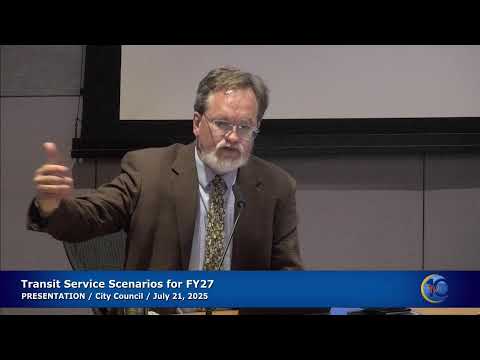
Charlottesville Area Transit staff and consultants on July 21 presented City Council with FY27 service-expansion scenarios that would increase frequency, add weekend and late‑night hours in some options, and require substantially more drivers, mechanics and operating funding; the council asked for more analysis but took no vote to adopt a scenario.
Charlottesville Area Transit staff and consultants on July 21 presented City Council with a set of FY27 service-expansion scenarios that would raise service frequency across the system, add weekend and late‑night hours in some options, and require substantially more drivers, mechanics and operating funding to implement.
The presentation, led by Garland Williams, director of Charlottesville Area Transit (CAT), and consultants from Nelson ygaard, outlined three tiers of change: (1) a baseline “system optimization plan” that brings most routes to 30‑minute frequency; (2) a full implementation with nearly all routes at 30 minutes and selected corridors at 15 minutes; and (3) higher‑service scenarios that extend late‑night hours and add additional 15‑minute corridors. Jim Baker of Nelson ygaard said the agency’s revised staffing estimates now range from roughly 82 operators for a constrained implementation up to 108 operators to deliver full 30‑minute weekday service, and as many as 137 operators for the most aggressive scenario.
Why it matters: higher-frequency service is the primary lever to grow ridership and improve access to work, health care and education in Charlottesville and parts of Albemarle County. But the city would need to decide whether to add operating funding and authorized driver positions in the upcoming budget; CAT staff told council the cost and staffing increases would also require more maintenance and supervisory capacity and would affect paratransit partners.
Most important facts
- Current baseline and inventory: CAT currently operates about 12 routes with a peak vehicle requirement of 20 buses and about 43 vehicles on property (three of which are slated for retirement, leaving 40); Garland Williams said the agency is authorized for 66 operator positions and that those positions are currently filled.
- Operator estimates: Nelson ygaard’s updated modeling shows 82 operators can achieve many service improvements short of full 30‑minute service, but the earlier 2022 estimate of 82 proved optimistic. Consultants now estimate roughly 90 operators are needed to deliver the original system optimization plan reliably and 108 operators to run a full 30‑minute system. The most extensive scenario would require up to 137 operators.
- Peak vehicles, spares and fleet: under the full 30‑minute plan peak vehicle need would rise to about 35 buses; the most aggressive scenarios would push peak vehicles to 41 and a fleet near 50 buses. With roughly 40 serviceable buses on property after retirements, staff warned spare ratios would fall well below best practice (about…
Already have an account? Log in
Subscribe to keep reading
Unlock the rest of this article — and every article on Citizen Portal.
- Unlimited articles
- AI-powered breakdowns of topics, speakers, decisions, and budgets
- Instant alerts when your location has a new meeting
- Follow topics and more locations
- 1,000 AI Insights / month, plus AI Chat