Get Full Government Meeting Transcripts, Videos, & Alerts Forever!
Get email alerts on the Transit Service Planning topic
No spam. Unsubscribe anytime.
Charlottesville transit officials outline service-expansion scenarios requiring up to 137 drivers and new funding
Summary
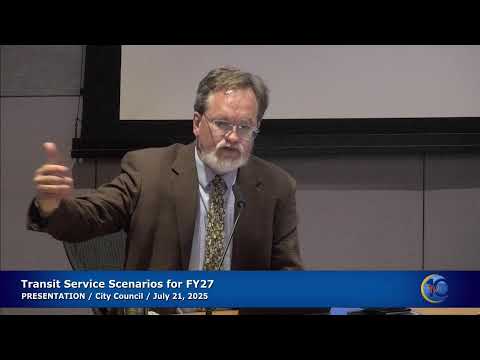
Charlottesville Area Transit staff and consultants on July 21 presented City Council with FY27 service-expansion scenarios that would increase frequency, add weekend and late‑night hours in some options, and require substantially more drivers, mechanics and operating funding; the council asked for more analysis but took no vote to adopt a scenario.
Charlottesville Area Transit staff and consultants on July 21 presented City Council with a set of FY27 service-expansion scenarios that would raise service frequency across the system, add weekend and late‑night hours in some options, and require substantially more drivers, mechanics and operating funding to implement.
The presentation, led by Garland Williams, director of Charlottesville Area Transit (CAT), and consultants from Nelson ygaard, outlined three tiers of change: (1) a baseline “system optimization plan” that brings most routes to 30‑minute frequency; (2) a full implementation with nearly all routes at 30 minutes and selected corridors at 15 minutes; and (3) higher‑service scenarios that extend late‑night hours and add additional 15‑minute corridors. Jim Baker of Nelson ygaard said the agency’s revised staffing estimates now range from roughly 82 operators for a constrained implementation up to 108 operators to deliver full 30‑minute weekday service, and as many as 137 operators for the most aggressive scenario.
Why it matters: higher-frequency service is the primary lever to grow ridership and improve access to work, health care and education in Charlottesville and parts of Albemarle County. But the city would need to decide whether to add operating funding and authorized driver positions in the upcoming budget; CAT staff told council the cost and staffing increases would also require more maintenance and supervisory capacity and would affect paratransit partners.
Most important facts
- Current baseline and inventory: CAT currently operates about 12 routes with a peak vehicle requirement of 20 buses and about 43 vehicles on property (three of which are slated for retirement, leaving 40); Garland Williams said the agency is authorized for 66 operator positions and that those positions are currently filled.
- Operator estimates: Nelson ygaard’s updated modeling shows 82 operators can achieve many service improvements short of full 30‑minute service, but the earlier 2022 estimate of 82 proved optimistic. Consultants now estimate roughly 90 operators are needed to deliver the original system optimization plan reliably and 108 operators to run a full 30‑minute system. The most extensive scenario would require up to 137 operators.
- Peak vehicles, spares and fleet: under the full 30‑minute plan peak vehicle need would rise to about 35 buses; the most aggressive scenarios would push peak vehicles to 41 and a fleet near 50 buses. With roughly 40 serviceable buses on property after retirements, staff warned spare ratios would fall well below best practice (about 20 percent spare).
- Costs: Nelson ygaard presented operating cost estimates (total, not net new) of roughly $15.08 million in the current budget baseline, about $16.9 million for the 82‑operator constrained scenario, about $22.5 million for the full 30‑minute system, and up to approximately $28 million for the highest‑service scenario that adds midnight service and multiple 15‑minute corridors. Consultants and staff emphasized those are operating figures only and do not include capital expenses for new buses if the city selected alternative‑fuel vehicles.
- City/county split and funding: Nelson ygaard estimated revenue‑hour splits would remain broadly similar to today (about a 69/31 city/county split under one scenario). CAT staff described current FY figures in the presentation: roughly $5.1–5.2 million federal operating support, $2.6 million state support, roughly $5.3 million city contribution and a first‑time county contribution of about $2.6 million, totaling about $15.08 million in the current operating plan. Staff said the agency is running a zero‑fare pilot through June 30 (decision on continuation not included in the presentation).
- Support‑staff needs: extending service hours would require more than drivers. Staff recommended additional mechanics, inventory specialists and supervisors for extended or 24‑hour maintenance operations. For a midnight‑service model CAT asked for a minimum of five additional mechanics and additional supervisors; a 24‑hour maintenance model would require more shifts and further staffing increases. CAT also noted that extending fixed‑route hours increases costs for Jaunt, the ADA paratransit provider; those costs had not been resolved and were “not specified” in the presentation.
- Service priorities and sequencing: consultants and staff recommended first raising system reliability and frequency (a system‑wide baseline such as 30‑minute headways) and then deploying 15‑minute service on the highest‑demand routes (for example the presentation cited Routes 5, 6, 7 and the downtown trolley as candidates). Nelson ygaard said the 82‑operator scenario could implement many network changes but not full Sunday service without sacrificing other weekday/Saturday improvements.
- On‑time performance and operations: CAT staff reported on‑time performance near the high‑60s percent (about 68–69 percent), below industry best practice; staff attributed much of the shortfall to operator shortages and a thin extra board that leaves short notice absences difficult to cover.
Equity and federal compliance (Title VI)
Consultant Greg Nordin explained federal Title VI obligations that apply because CAT receives federal funds. He summarized the standard behind Title VI and the FTA circular that guides transit providers and said Charlottesville’s Title VI program must be updated on a three‑year cycle; CAT’s current program is due to expire in November. Nordin told council the circular (FTA C 4702.1B) requires a Title VI program, a complaint process and logs, a public‑participation plan, a language‑assistance plan and a facility siting assessment for operational facilities. He noted additional data‑reporting and equity‑analysis requirements apply only when an operator meets higher thresholds (for example, operating more than 50 vehicles in peak service and being in a UZA over 200,000 people), which Charlottesville does not currently meet, though staff said the agency is trending larger.
Nordin emphasized timing and process: "Title VI is meant to be a floor, not a ceiling," and recommended incorporating equity review early in planning so service changes are defensible and do not create disparate impacts. He said Title VI analyses typically examine the distribution of service against demographic maps and that major service or fare changes require an equity analysis. Council members raised the practical question of whether focusing extra service on certain corridors (15‑minute routes) could be justified under Title VI; consultants and staff counseled that setting a systemwide baseline (for example 30 minutes) and then phasing targeted higher‑frequency corridors creates a defendable, data‑driven approach.
Council response and next steps
Council members repeatedly framed the issue as a budget and priority question: whether the city will identify transit as a top priority and authorize the additional full‑time equivalents and recurring funding needed in the FY27 budget. A council member summarized the estimated salary cost per driver and said implementing the system optimization plan would require roughly $2–3 million in additional recurring local funding for driver positions alone, with higher figures at larger service levels.
Staff asked for policy guidance rather than an immediate decision and invited council direction on which scenarios to pursue in the fall budgeting process. Nelson ygaard asked whether council wanted additional scenario variants, including staging 15‑minute service on select corridors only after the rest of the network reaches the targeted baseline frequency.
Votes at a glance
- Permission for Councilor Lloyd Snook to participate electronically (vacation in Virginia): motion made and seconded; council granted permission by voice vote. (Mover/second not specified in the transcript; exact roll‑call tally not specified.)
- Motion to approve/amend the agenda: motion made and seconded; council approved by voice vote. (Mover/second not specified in the transcript; exact tally not specified.)
- Motion to convene in closed session under Virginia Code §2.2‑3711(a)(7),(a)(8) and (a)(1) (litigation, legal advice on zoning ordinance, prospective CRHA appointments): motion moved and seconded; council approved and convened in closed session. (Mover/second not specified in the transcript; exact tally not specified.)
What was not decided
Council did not adopt any of the service scenarios or appropriate funding at the meeting. Staff told council the presentation was intended to inform the upcoming budget process; council members requested follow‑up analysis and additional scenario variants (for example phased 15‑minute corridors with a citywide 30‑minute baseline).
Clarifying details cited by staff (transcript excerpts)
- Current authorized operator positions: 66 (all positions filled at the time of the presentation). - Current peak vehicle requirement: 20; current vehicles on property: 43 (three to be retired, leaving ~40). - 82‑operator scenario: ~31,000 additional annual revenue hours; estimated total operating cost shown as about $16.9 million (total, not net new). - Full 30‑minute implementation: estimated ~108 operators, 35 peak vehicles, ~$22.5 million operating cost. - Highest scenario (midnight service + additional 15‑minute corridors): up to 137 operators, 41 peak vehicles, about $28 million operating cost; fleet near 50 buses and the recommendation to add 20% spare ratio when planning fleet size. - Title VI: CAT’s Title VI program is on a three‑year cycle and is due for update in November; FTA circular C 4702.1B and Executive Order 12898 (environmental justice) guide requirements; operational facility siting assessments are required when applicable.
Sources and next steps
The information above is drawn from the July 21, 2025 Charlottesville City Council meeting work session presentation by Charlottesville Area Transit and Nelson ygaard consultants. Staff asked council for guidance to shape the FY27 budget and to indicate scenario preferences; council members signaled interest in prioritizing a systemwide reliability baseline (for example 30 minutes) ahead of broader, costlier options but did not adopt a preferred scenario at the meeting. CAT and consultants offered to return with additional scenario variants and more detailed cost and staffing breakdowns for council budget deliberations.