Get Full Government Meeting Transcripts, Videos, & Alerts Forever!
Get email alerts on the Comprehensive Plan Update topic
No spam. Unsubscribe anytime.
Spokane staff outline major updates to comprehensive plan’s natural environment chapter
Summary
City planning staff on June 5 presented first-pass changes to the natural environment chapter of Spokane’s 10‑year comprehensive-plan update, describing how new language will fold in state requirements, link to technical studies and aim to make the plan more usable.
City planning staff on June 5 presented first-pass changes to the natural environment chapter of Spokane’s 10‑year comprehensive-plan update, describing how new language will fold in state requirements, link to technical studies and aim to make the plan more usable.
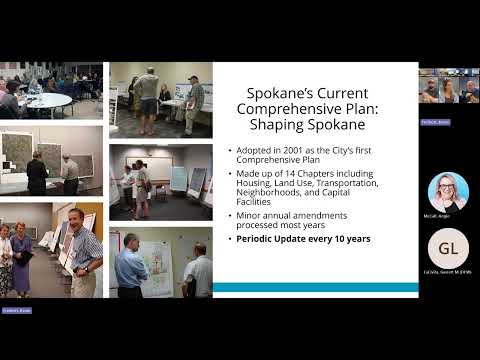
The presentation, led by a city planning staff member identified in the meeting as Kevin (staff member), said the update is part of the larger Plan Spokane 2046 effort and will incorporate state Growth Management Act requirements, recent housing work and other technical studies. Kevin said the city’s current plan is “Shaping Spokane” (2001) and described the update as the first substantial rewrite since then.
Why it matters: the natural environment chapter guides decisions about wetlands, floodplains, geologic hazards, wildlife habitat and features unique to Spokane — including basalt outcrops. Changes to the chapter will influence mapping and zoning choices, the municipal code’s critical-areas rules and future development review.
Most important changes and discussion
- Rock outcrop protection: Staff proposed a new or clarified policy to identify and protect basalt and other rock outcrops that have geological, visual or cultural value. Kevin and other staff emphasized the policy is intended to “find the ones that have value” and protect those, not to prohibit ordinary property owners from removing small or non‑significant rock features. Commissioners pressed staff on how a protection policy could be applied in practice and warned it could be used to block development if written too broadly. Staff said the municipal code and critical-areas regulations, not the comp plan alone, would define concrete procedures and exceptions.
- Critical areas and statutory alignment: Staff reiterated that critical areas (wetlands, aquifer recharge areas, frequently flooded areas, geologically hazardous areas and fish and wildlife habitat conservation areas) are state‑mandated and will be updated in the city’s code in parallel with the plan. The team said portions of the chapter are being tightened to reflect state minimums and to provide clearer cross-references to technical studies and the code.
- Floodplain language and FEMA: The draft removes any suggestion the city can redesignate FEMA floodplains. Staff said FEMA manages the official 100‑year floodplain designation and the city’s role is to manage development and zoning choices informed by that process. The draft uses terms such as “discourage development in the 100‑year floodplain” rather than prohibition, and staff said those policies would later inform land‑use alternatives and mapping.
- Urban forestry and street trees: Staff moved several items from discussion into policy, including a stronger emphasis on street‑tree maintenance and education for property owners. A tree‑canopy target was shown in the draft text (the slide mistakenly listed “30% canopy coverage in every neighborhood by 2023”); staff acknowledged the date was a typo and said they would confirm the correct target and citation. Staff also added a policy to make tree replacement and “no net loss” concepts explicit in policy language.
- Parks and park master plan links: The planning team said the parks master plan will remain the principal source for park actions and capital projects; the comp plan policies will be adjusted to support, not duplicate, that plan. Staff recommended committee members read the parks master plan before the next meeting.
- Terminology and equity concerns: Staff described deliberate edits to avoid terms that have become exclusionary in some contexts. Examples: replacing or qualifying “neighborhood character” and reducing use of the word “citizen” in favor of broader phrases such as “members of the public.” Staff said these changes reflect community input that some terms can be weaponized to exclude housing or other changes.
Process, timing and logistics noted at the meeting
- Shorelines: Staff said the shoreline chapter will not be updated in this cycle because revising it would trigger a separate state process. Kevin said, “We are not touching shorelines” for this update round.
- Cross references and digital format: The new draft will be more web‑linked (e.g., links from comp-plan policies to technical studies or related chapters) to improve usability instead of long discussion text embedded in the plan.
- Meetings and next steps: Staff noted this subcommittee will review the chapter in two meetings and that key topics will later be taken to the full planning commission. The next subcommittee meeting was listed in the discussion as June 18 at 2:00 p.m.; staff also said the June 30 meeting had been moved to July 3. Staff asked participants to cite policy numbers when raising specific edits and said submissions and public comments can be sent to planspokane@spokanecity.org or submitted via PlanSpokane.org.
Meeting hiccup: staff reported the slide presentation failed to upload to the server; the group reviewed the draft text ad hoc and staff said they would correct slide dates and reissue updated documents with version dates on each file.
What the draft did not decide
- No formal votes or actions were taken by the subcommittee. Staff noted policies would continue to change and that items flagged as large or contentious would return to the full planning commission.
- The draft language contains a mix of policy and cross‑references that will be refined; specific code changes for critical‑areas buffers, tree protections or rock‑outcrop permitting were not finalized at this meeting.
Ending
Staff urged subcommittee members to read the posted draft and the parks master plan in advance of the next meeting and to send comments by email. For public participation, staff repeated the Plan Spokane website and email address and invited written comments for the record.