Get email alerts on the Data Centers Zoning topic
No spam. Unsubscribe anytime.
Cannon Falls reviews draft ordinance to allow data centers under conditional use permits
Summary
At a July 21 joint work session, Cannon Falls officials reviewed a proposed text amendment to allow data centers as a conditional use (CUP) in I-2 zoning, with subsequent review via planned unit development (PUD) and annexation steps; no ordinance vote was taken.
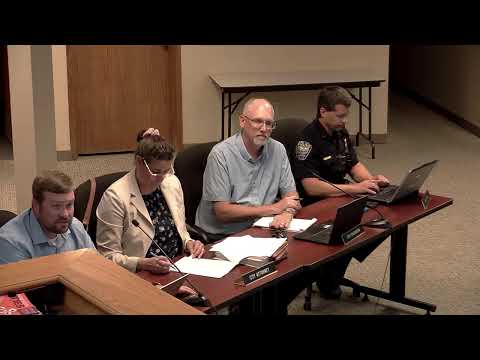
Cannon Falls city council members and planning commissioners met in a joint work session Monday, July 21, to review a draft text amendment that would add “data centers” as a conditional use in the city’s I‑2 industrial zoning and enable later, site‑specific review through a planned unit development overlay.
The draft ordinance before the bodies would permit data centers subject to conditional use permitting, infrastructure review and specific mitigation measures. John (staff member) briefed the elected officials and planning commissioners: "So before us tonight ... there is a public hearing to discuss the text amendment" and said the draft is intended to give the city a framework to evaluate future projects rather than simply permit them outright.
The draft places data centers in the I‑2 zoning district and lists conditions that applicants would have to meet, including measures to control noise, light, air and water pollution and infrastructure assurances approved by the city engineer. Staff said those conditions are intentionally broad so the city can adapt to evolving technologies and to reserve authority to require additional measures at the CUP and PUD stages. "The framework for the conditions is here to give you the flexibility depending on what the particulars are in the future," a staff speaker said.
Council members and commissioners pressed staff on specific elements the draft does and does not address. Diane Zimmerman asked whether the ordinance should differentiate types of on‑site generators and whether diesel generators would require a variance: "Did we specifically want to make sure that diesels would have to be, a variance then?" Staff replied that the draft intentionally uses broad language ("electrical generators") to cover diesel, natural gas, battery and other backup power sources and that more detailed requirements could be refined later in conditions or a PUD.
Other questions centered on infrastructure and authority. Council member Jesse asked whether "enclosed energy" meant battery storage; staff replied it was intended to mean enclosed battery and fuel storage facilities. Several members noted water and wastewater capacity reviews had been completed earlier in the process and that annexation with Randolph Township was required for the city to have land‑use jurisdiction for the site under discussion. Staff said agency review for the AUAR (Alternative Urban Area‑wide Review) is underway and notices were sent to agencies on the day of the work session.
Officials discussed regulatory limits the city would, and would not, control. Staff and council members noted the city does not regulate wholesale electric supply and that power capacity and procurement fall to the utility (Dakota Electric) and state regulators (the Minnesota Public Utilities Commission). "Power is not our concern," a staff member said, explaining the city lacks municipal electric utility authority; electricity availability and any larger generation decisions would be handled by the utility and state regulators.
The council debated whether to prohibit particular uses within the broad "data center" definition — for example, facilities dedicated to cryptocurrency mining or other extremely energy‑intensive operations — or to instead regulate by measurable limits such as site power demand. Staff cautioned that restricting uses by content or purpose can raise legal and administrative questions; they suggested limiting by objective factors (infrastructure, environmental impacts, compliance history) during CUP review.
Council members also contrasted the current approach with a moratorium. Several members asked whether the city should have imposed a moratorium to pause permitting while drafting rules. Staff said they had conducted studies and held prior work sessions and judged that a targeted code amendment with CUP review would give the city the necessary authority without an outright pause.
No vote was held on the ordinance at Monday’s work session. The amendment will proceed to a required public hearing and a planning commission public meeting; staff said the planning commission will hold the first formal evaluation and the public may comment during that hearing. Representatives of the project applicant (identified in staff materials) were present and available to answer questions. The work session concluded with procedural motions to approve the meeting agenda and to adjourn; no final action on the ordinance was taken.
AI generated
The text on this page is AI generated. Summaries, highlights, analysis, and video transcripts are all produced from the original source material.
AI can make mistakes, so if you spot one, and we will fix it for everyone.
Note: the source content is unaltered by us. Any content source we link to, be it a video, an audio recording, or a document, is presented exactly as its publisher released it. That publisher is usually a government body, sometimes an individual official or another organisation.