
Issaquah committee weighs future of TOD Opportunity Center after service providers withdraw
Get AI-powered insights, summaries, and transcripts
Subscribe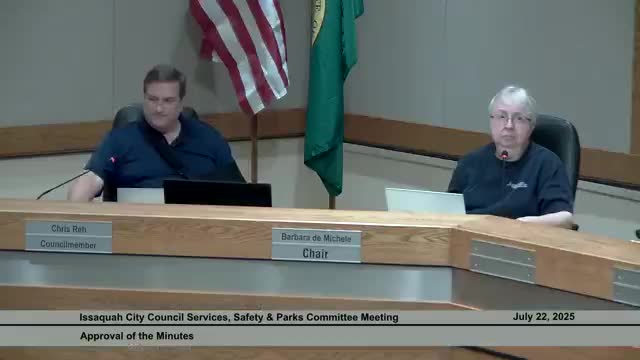
Summary
Issaquah Deputy Council President De Michel and the Services, Safety and Parks Committee on July 22 heard options for the Transit Oriented Development Opportunity Center after two planned tenants withdrew, and city staff asked whether to pursue a new single provider or instead prepare a shared-tenant backup to meet funding and timeline constraints.
Issaquah Deputy Council President De Michel and the Services, Safety and Parks Committee on July 22 heard options for the Transit Oriented Development Opportunity Center (TODOC) after the two planned tenants, Valley Cities and HealthPoint, withdrew their participation. City staff asked the committee whether it wants the administration to continue pursuing a single service provider similar to the original plan or instead develop a plan B to share the space among smaller providers and city human services staff.
The decision matters because roughly $9 million the city has set aside for acquisition and tenant improvements is tied to specific uses and deadlines, and the King County Housing Authority (KCHA) — which owns the parcel and is moving toward building permits this summer — needs timely direction to finalize building plans. City staff told the committee that the state reappropriation of $3 million for the Opportunity Center expires June 30, 2027, and that the city is working toward a May 2028 opening if the project remains aligned with the residential TOD schedule.
City staff presented the history and the constrained timeline. Andrea Snyder, deputy city administrator, said, “the purpose of our meeting is to talk about what, what, is the future for the opportunity center.” The city issued the original request for proposals in 2016 and later negotiated an MOU with Valley Cities and HealthPoint for the 10,000-square-foot commercial condominium within the TOD. KCHA retains ownership of the land. Snyder told the committee that Valley Cities and HealthPoint “pulled out of this partnership with us” citing timing and uncertainty in Medicaid and federal grant funding.
Management analyst Jillian Straub laid out the funding landscape and options. Straub said, “the city has called has set aside, a little bit over $9,000,000 in existing funds to support the, construction acquisition and tenant improvements and some portion of the tenant improvements for the TODOC.” She described four funding buckets the city plans to use, including affordable housing sales tax revenue (subject to state law limits on capital vs. operating splits), funds from a development agreement (referred to in the packet as TELUS/TALES development agreement), prior human services campus funds, and the $3 million state reappropriation that is the most restricted. Straub warned the committee that the $3 million must be spent and submitted for reimbursement to the state Department of Commerce by June 30, 2027, or it will lapse.
City staff summarized the options and trade-offs: - Preferred path (Option 1): Pursue another single, larger service provider (similar to Valley Cities/HealthPoint). Staff said this best matches how current funds were requested and would likely allow use of the full funding package. The city’s level of control would be low (decisions depend on providers and federal funding conditions), but staff estimated the center could directly serve more than 5,000 residents, based on prior estimates. Straub noted an estimated core-and-shell cost of about $6,000,000 and that tenant improvements could push total costs closer to the $9,000,000 already set aside. - Shared-provider model / city-hosted rotating services (Plan B): Move the human services division into the space and host smaller rotating providers who lease portions of the center for limited days. Staff said this could allow use of most funding but would increase ongoing city subsidy and operational commitment (they estimated an additional roughly 1.0 full-time equivalent to manage the center). Staff said smaller providers might need subsidized rent and that the city would bear more property-management responsibilities. - Transitional housing: Using the space as transitional housing would likely forfeit the $3 million state appropriation because that funding was requested specifically for behavioral, dental and medical services close to transit. Some other funds could be used, but staff said the project would lose most existing dedicated funds. - Pull out: The city could inform KCHA it will not acquire the commercial condominium; KCHA could then redesign the space for housing or other uses. Staff said this would free funds for other uses but also relinquish control of that space in the TOD.
Committee members questioned feasibility and timelines. Council Member Martz sought confirmation that the intent had been to open the Opportunity Center coterminous with the housing in May 2028; Snyder confirmed that is the target but acknowledged the center could open later if construction timing changed. Council Member Ray said he was "dubious" a suitable provider could be secured within the available timeline and warned that building the center without an identified provider (the panel’s described Option 4) would be the worst outcome. Council Member Martz and others asked staff to examine operating models used by the Together Center and similar facilities to test the shared-provider approach. Parks Director Jeff Watling noted the Together Center and other regional models exist but said detailed operational due diligence is needed.
On costs and funding constraints, Straub and Snyder reiterated that the estimated core-and-shell acquisition/construction cost was about $6,000,000 and that tenant improvements, mechanical systems and interior build-out could push the total nearer the $9,000,000 set aside. Straub emphasized the most restrictive bucket — the state reappropriation — requires that work be under contract with Commerce and reimbursement submitted by June 30, 2027.
Next steps and committee direction: Administration requested that the committee allow staff to continue pursuing talks with a prospective single provider and, in parallel, investigate the feasibility of a shared/provider model including identifying potential operators to manage the center. The committee agreed to a special meeting in August (staff to confirm date) to review findings and to prepare a recommendation for full council action in September. During the meeting, staff asked the committee to provide feedback quickly because KCHA plans to apply for building permits in August and will need notice if the city intends to decline acquiring the commercial condominium so KCHA can redesign the space.
The committee did not take a formal roll-call vote on a single option at the July 22 meeting. The explicit next action recorded was agreement to schedule a special committee meeting in August for additional due diligence and to bring recommendations back to the full council in September. Staff also said they would continue conversations with at least one promising potential provider in the near term and would further vet rotating-provider models used in the region.
The administration’s presentation, the committee discussion, and staff’s stated timeline leave the city facing a constrained, two-year reimbursement window for the state funds and a narrow scheduling window to inform KCHA of whether the city intends to proceed with acquiring the commercial condo. The committee requested additional outreach to human services providers and rapid follow-up from staff; the committee will reconvene in a special meeting in August to consider a more developed recommendation.