Get Full Government Meeting Transcripts, Videos, & Alerts Forever!
Get email alerts on the Annexation topic
No spam. Unsubscribe anytime.
Trustees set Aug. 11 hearing on 900‑unit annexation; members flag density and infrastructure questions
Summary
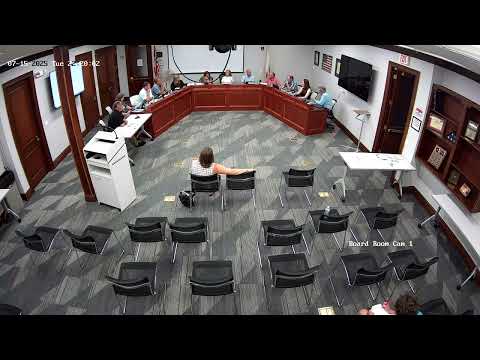
Trustees agreed to hold a public hearing on a proposed 900‑unit annexation on Aug. 11 and discussed concerns about planned densities, sewer and water capacity, conservation‑design math that can inflate density metrics, and legal public‑notice timelines.
The trustees agreed during a regular meeting to set a public hearing for the proposed 900‑unit annexation for Aug. 11, with the hearing location to be confirmed and the draft annexation agreement to be posted for the public at least 15 days before the hearing. The board discussed whether the comprehensive plan’s mapped “yellow” future‑growth areas and density targets reflected achievable infrastructure capacity.
The hearing date was chosen after trustees and staff reviewed publication deadlines and school‑district coordination. Trustees said the agenda packet and the annexation agreement must be placed on file and available for review by the public for 15 days before the hearing; the final hearing location was left contingent on facility availability, with two options mentioned: a church at 38 LaFox Road or the standard school facility in Belgrade.
Trustees raised several substantive planning issues during discussion. One participant noted a referenced density target — 2.5 to 3.5 homes per acre — and questioned how that figured with local infrastructure limits, including sewer and water capacity and the likely need for septic in some rural parcels. Another participant explained how conservation‑design clustering can make a development appear to meet 2.5–3.5 homes per acre on the buildable cluster, while the overall project acreage can effectively yield only about one home per acre across the entire parcel once protected open space is counted.
Trustees also referenced an outside planning map that, in one version, showed a warehouse district between Silver Glen and Plato and asked how the Illinois Department of Transportation (IDOT) corridor planning dovetails with the village comprehensive‑plan mapping for Group 47. Participants emphasized that some mapped land uses come from external or county/regional plans and that the village does not control every boundary shown on those external maps.
On process, trustees discussed meeting logistics and legal constraints for pre‑hearing changes. Staff cautioned that if language in the annexation agreement changes after the document has been posted for the 15‑day public review period, the public could reasonably say the version in hand differs from what was published; trustees agreed that major amendments should be avoided after posting and that any substantive changes should be coordinated and re‑posted to preserve public notice expectations. Trustees also confirmed the availability of additional small meetings with counsel and staff to resolve language before the hearing, including the option for two trustees at a time to meet with the village attorney to review details.
The board discussed scheduling additional special meetings in late August to finish remaining business and to allow time for review of the annexation agreement and other outstanding items. Trustees said they would continue periodic meetings with the developer’s representatives and third‑party district representatives in the weeks leading up to the hearing. No formal vote on annexation or on the agreement text was taken at the meeting; the Aug. 11 hearing was set as the next formal public step.
The meeting record shows trustees maintained a pragmatic tone: framing the comprehensive plan and annexation materials as guiding or aspirational documents rather than guaranteed outcomes, while flagging infrastructure, school‑district coordination and public‑notice procedures as constraints that could affect timing or content of any final annexation agreement.