Get Full Government Meeting Transcripts, Videos, & Alerts Forever!
Get email alerts on the Policing Grants Accreditation topic
No spam. Unsubscribe anytime.
Speakers raise concerns about limits of Ohio Collaborative standards as council places police-related DOJ grant applications on consent
Summary
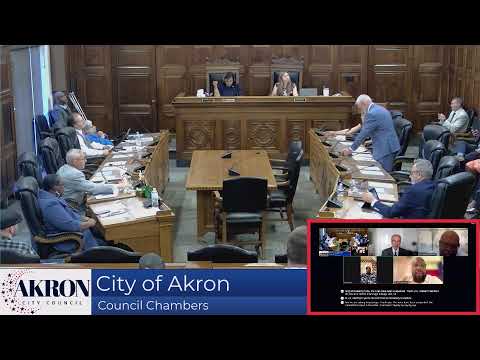
Public commenters questioned whether Ohio Collaborative accreditation equals robust policy reform as Akron City Council placed several Department of Justice policing grant applications on the consent agenda during its July 21 meeting.
Public comment at the Akron City Council’s July 21 meeting raised concerns that Ohio Collaborative certification sets only minimum standards for use-of-force policy even as council moved multiple U.S. Department of Justice policing grant applications to the consent agenda. Jennifer Boswell, a Ward 4 resident and retired state corrections employee, and a second commenter identified as Janos urged council to pair accreditation efforts with stronger local policy administration and community oversight.
Boswell told council she supports the Community Oriented Policing Services (COPS) accreditation grant program but warned certification alone can be limited. “The current policy statements of the Ohio Collaborative regarding the use of force and use of deadly force is exactly 4 sentences long,” Boswell said. She added that, under the collaborative’s documentation requirements, an agency can be certified by showing it has a policy, disseminated that policy, trained sworn personnel on it, and has an internal reporting procedure — steps Boswell said do not demonstrate the policy’s effectiveness or alignment with Akron’s community.
Janos linked broader concerns about violence and policing to international human-rights issues and local police killings, saying, “It has been 235 days since Jasmine Tucker was gunned down by APD, and it has been 11 months since Mike Jones has been gunned down by the APD.” Those remarks were made as part of a longer public-comment statement.
Councilman McKittrick offered a slate of ordinances that would authorize the mayor or his designee to apply for and, if awarded, accept and expend various DOJ and related grant funds for Akron Police Department programs. Items introduced by McKittrick on the agenda included applications for the DOJ COPS LE Safer Outcomes program, ICAT-related grants, an accreditation grant program, hiring grants, explorer/micro grants, and related law-enforcement wellness and training funds. In the meeting, each of those items was placed on the consent agenda; the transcript does not record a separate final roll-call approval for those specific ordinances later in the docket.
Why it matters: Council action to seek DOJ funding could add resources for training, accreditation, hiring and wellness programs at the Akron Police Department, but public comment emphasized that grant-funded accreditation alone may not change how use-of-force policy operates in practice without stronger local policy administration and community-engagement mechanisms.
The most salient facts: Boswell, who described experience in corrections policy development and audits, recommended that the grant be paired with a “robust policy administration program” to work collaboratively with the community to ensure accountability and public confidence. McKittrick’s measures were procedural during the meeting: he introduced the ordinances and had them placed on the consent agenda for action as part of the council’s consent process.
Context and next steps: The transcript shows the ordinances were placed on the consent agenda, but the meeting record in the provided transcript does not show separate roll-call votes approving those particular items. If council ultimately accepts DOJ awards, the scope and conditions of each grant — including whether accreditation work will include community-facing policy administration positions — will depend on the grant terms and subsequent council or mayoral actions.