Get Full Government Meeting Transcripts, Videos, & Alerts Forever!
Get email alerts on the Tax Increment Financing topic
No spam. Unsubscribe anytime.
Marathon County approves guidance for TIF joint-review board votes and orders report on representative’s use of standards
Summary
After debate and failed amendments seeking to make the guidance mandatory, the county board adopted a resolution asking the county's representative to joint review boards to consider 10 standards from the Wisconsin TIF manual and to deliver a report on implementation by Aug. 1, 2026.
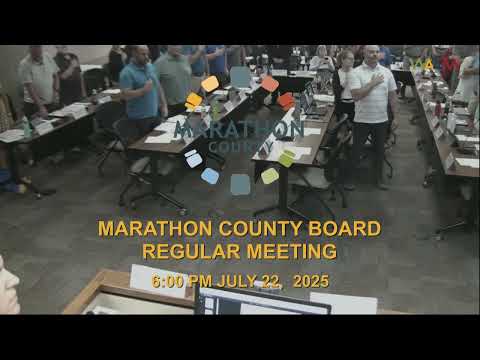
The Marathon County Board of Supervisors on July 22 adopted a resolution directing the county's representative to joint review boards to use the Wisconsin Department of Revenue's ten “questions to consider” when evaluating proposed tax incremental financing (TIF) districts, and added a requirement that the representative report to county committees and the board on the use and effects of those guidelines.
Why it matters: Tax incremental financing is a development tool that diverts incremental property tax revenue to pay public infrastructure and other costs inside a district. County supervisors debated whether the board could, or should, require the representative to follow the ten standards or simply ask them to consider the questions; legal and practical concerns about mandating answers dominated discussion.
The process: The resolution was introduced by Supervisor Marash and seconded by Supervisor Rosenberg. Supervisor Rosenberg offered an amendment that would have changed the word "consider" to "require" for the ten standards; that amendment failed after discussion about whether a county resolution could legally impose mandatory duties on a representative and whether the standards could be applied uniformly to all TIF types.
Corp. Counsel Perner advised that using "require" could create a mandate in the resolution and would need clear guardrails if the board intended to remove discretion from the county's representative. Administrator Leonard warned that several of the ten standards are open-ended and may not be answerable with a simple met/not-met box; he said his office and staff could facilitate discussion but cautioned against setting staff up for impossible or legally risky tasks.
Another amendment, offered by Supervisor Rosenberg, would have limited a district’s projected repayment term by stating that a TIF should not be approved if projected repayment to taxpayers exceeded 38 years; that amendment was also defeated after legal caution that counties cannot exceed state authority and judicial risk was raised by Corp. Counsel Perner.
A reporting amendment offered by Supervisor Robinson — directing Marathon County's TIF representative to deliver a report to the Extension, Education and Economic Development Committee and to the chair of the county board on or before Aug. 1, 2026 — was adopted. Robinson said the change came from the TIF task force and aimed to provide periodic, transparent updates to the board on how the guidelines were applied by county representatives at joint review boards.
Formal action: The board adopted the resolution (Resolution 36-25) as originally drafted, with the added requirement that the county representative deliver a report on or before Aug. 1, 2026. The motion to adopt the resolution as amended passed but was not unanimous.
Discussion highlights: Speakers stressed the limits of county authority under state law, the need for the county representative (typically the finance director) to have discretion when applying the standards, and the value of requiring a report to the county to improve oversight. Supervisor Fiffrick argued the ten questions recognize that some projects would not proceed "but for" TIF assistance and cautioned against unduly restricting TIF use; Supervisor Robinson emphasized that the county can only bind its own representative, not other joint-review-board members.
Ending: The resolution directs Marathon County’s representative to use the ten consideration questions from the Wisconsin Department of Revenue manual as guidance and requires a follow-up report to the board by Aug. 1, 2026; the board rejected amendments that would have made the standards mandatory or that would have added a 38-year repayment cap.