Marathon County board adopts solid-waste plan; directors say loan application needed to pursue $12.8 million project
Loading...
Summary
The Marathon County Board of Supervisors adopted a solid waste environmental management plan that lays the groundwork to seek an estimated $12,800,000 environmental loan; the plan does not bind the county to accept loan funds, and a 2003 tri-county agreement may share repayment obligations with Portage and Shawano counties, officials said.
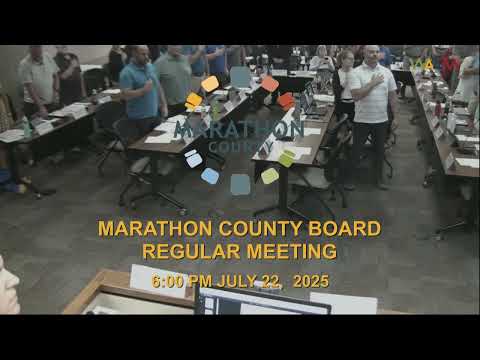
The Marathon County Board of Supervisors on July 22 adopted the county's Solid Waste Environmental Management Plan, a blueprint officials said is needed to apply for state environmental loan funding for landfill work. The board voted to adopt the plan by roll call after discussion; the motion was made by Supervisor Ritter and seconded by Supervisor Kroll.
The plan, which was described during the Environmental Resources Committee report, is intended to be the basis for an application the county would submit for what Solid Waste Director Hagenbusher described as an environmental loan in the neighborhood of $12,800,000. “We stand no chance of even getting any principal forgiveness on it if we don't submit a plan and an application,” Hagenbusher said at the meeting.
Why it matters: Board members and staff said submitting a formal plan is necessary to get state officials to score and rank the project for funding. If the state does not rank Marathon County highly enough, county leaders said they would need to return to the board to consider alternative funding mechanisms.
Board discussion focused on the scope and the financial implications. Supervisor Jensen asked whether approving the plan would commit the county to accepting the loan and whether the plan covered existing multi-county agreements to handle landfill leachate. Hagenbusher said the plan is a mechanism for funding the project and that state ranking will determine whether funding or principal forgiveness is available. On the multi-county question, he said Marathon County entered a tri-county agreement in 2003 with Portage and Shawano counties that runs through February 2032 and assigns responsibility to all three counties for unforeseen costs related to managing the landfill.
Corp. Counsel Perner told the board that adopting the plan itself does not legally obligate the county to accept loans or grants. “In the event any loans or grants were offered to the county, the board would have to separately act to accept, receive, and approve them through a budget amendment,” Perner said.
Supervisor Robinson, speaking about the tri-county relationship, urged careful negotiation with Portage and Shawano to ensure those counties share capital and repayment responsibilities during both the operating life of the landfill and the long-term care period.
Formal action: Motion to adopt the Marathon County Solid Waste Environmental Management Plan (Resolution 45-25) was made by Supervisor Ritter, seconded by Supervisor Kroll, and adopted by the board. The adoption authorizes the county to proceed with the plan and positions the county to apply for state environmental loan funding; it does not itself accept loan funds.
What the board did not do: The board did not, and Corp. Counsel confirmed it would not, become legally bound at adoption to accept an environmental loan or to commit county funds without a separate vote and budget amendment.
Next steps: County staff said they will pursue the state loan application and return with details on ranking, potential principal forgiveness, and alternatives if the state declines or ranks the project too low for assistance.
Ending: The board adopted the plan after the Environmental Resources Committee recommendation; no specific timeline for the loan application was given during the meeting.