Get Full Government Meeting Transcripts, Videos, & Alerts Forever!
Get email alerts on the Public Transit topic
No spam. Unsubscribe anytime.
Pierce Transit outlines scaled Destination 2045 plan, proposes more frequent service and later hours for Milton routes
Summary
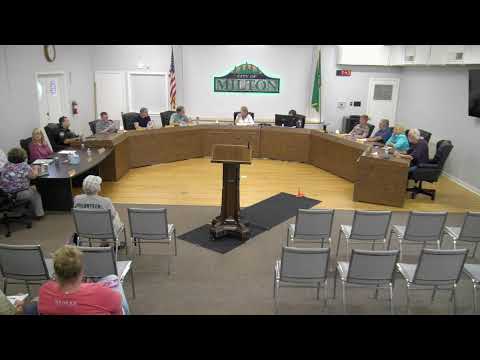
Pierce Transit officials told the Milton City Council on July 21 that a revised, financially constrained draft of the agency’s Destination 2045 plan would expand frequency and hours, with route-level improvements that would affect Milton’s 501 and 402 lines.
Pierce Transit officials told the Milton City Council on July 21 that a second draft of the agency’s Destination 2045 long-range plan narrows earlier, more-aspirational proposals so the plan can be implemented with realistic funding.
The revised draft, presented by Andrew Arness, assistant manager for service planning at Pierce Transit, lays out a baseline that Pierce Transit says is achievable with existing revenue — principally the agency’s 0.6% sales-tax levy — and two larger growth scenarios that would require voter approval of a higher sales tax or a change in state law.
"The feedback that we did receive on the first draft of the plan was just for more service in general," Arness said, summarizing public input gathered during more than 65 outreach events and a survey with more than 700 responses. He said about 75% of respondents were current Pierce Transit riders.
Why it matters: Milton is served by Pierce Transit routes 501 and 402. Under the draft’s baseline scenario, Pierce Transit would increase annual service hours from roughly 470,000 today to about 482,000, add limited frequency improvements and extend evening service toward an average 10 p.m. finish time on many routes. Under a sales-tax increase to 0.9% (which would require a voter-approved ballot measure), the agency modeled roughly 600,000 annual service hours and wider frequency improvements. A further modeled scenario that would raise the tax to 1.1% — which Pierce Transit said would require a change to the Revised Code of Washington — would allow approximately 750,000 annual service hours.
On route-level changes affecting Milton, Pierce Transit said it would: - Increase route 501 to a 30-minute frequency on Sundays in the larger scenario and to 30-minute frequency on weekdays and Saturdays in the smaller growth scenario, and extend operating hours to about 10 p.m. on Saturdays and Sundays. - Increase route 402 to 30-minute frequency on weekdays and Saturdays and extend weekend operating hours toward 10 p.m.
Pierce Transit also said it removed three proposed bus-rapid-transit (BRT) corridors from the second draft because capital costs for BRT lines — "in the ballpark of like 50 to $100,000,000 apiece," Arness said — would have reduced systemwide service hours. Instead, the agency is prioritizing higher-frequency, lower-infrastructure "high-capacity" services that operate every 15 minutes on core corridors and adding four new routes that would serve about 100,000 more people across the agency’s service area.
Council members pressed staff on details. Council member Whelan asked why not all stops have shelters; Arness said Pierce Transit recently set stop-shelter standards and that a shelter typically requires an average of about eight boardings per day to qualify. Council member Cedar asked for a list of planned capital improvements in Milton related to shelters; Arness agreed to follow up. Council member Hall asked about dedicated transit lanes; Arness said those speed and reliability improvements require additional grant funding and multi-jurisdictional partnerships and are not scheduled as specific projects in the draft.
Pierce Transit described next steps: the agency will continue outreach and planned to present a final plan for board consideration on Aug. 11, 2025. Arness said the second draft intentionally focused on financially sustainable, near-term actions rather than the more aspirational elements of the first draft.
Notes on uncertainty and limits: the presentation modeled three funding/service scenarios (baseline at current levy, a 0.9% sales-tax ballot measure scenario, and a hypothetical 1.1% scenario that would require a change to state law). Pierce Transit said specific routing and shelter placements will depend on further analysis and local coordination; council members requested that the agency provide Milton-specific capital and stop-shelter plans.
Ending: Pierce Transit officials said they will return requested route- and shelter-specific data to Milton staff and to council members as the plan proceeds toward an August board decision. "We'd be happy to provide that information for you," Arness said when council members asked for route-level ridership and capital details.