Get Full Government Meeting Transcripts, Videos, & Alerts Forever!
Get email alerts on the Leaf Blower Ordinance topic
No spam. Unsubscribe anytime.
Salem councilors advance gas-leaf-blower ordinance to committee after wide discussion of health, equity and city exemptions
Summary
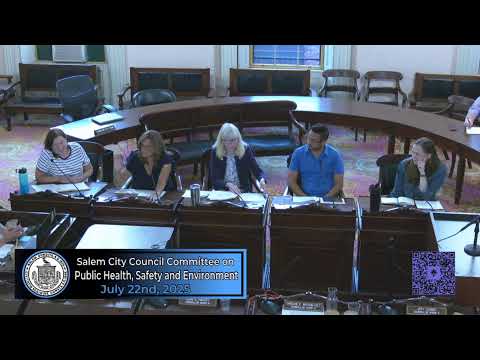
Chair Diane Cohen convened a joint meeting of the Salem City Council Committee on Public Health, Safety, and Environment and the Committee of the Whole on July 22 to discuss a proposed ordinance by Councilor Brandon Merkel and Councilor Alex Davis that would restrict gas-powered leaf blowers between Memorial Day and Labor Day.
Chair Diane Cohen convened a joint meeting of the Salem City Council Committee on Public Health, Safety, and Environment and the Committee of the Whole on July 22 to discuss a proposed ordinance by Councilor Brandon Merkel and Councilor Alex Davis that would restrict use of gas-powered leaf blowers during the summer season. After several hours of testimony from department heads, councilors and residents, the committee voted to keep the ordinance in committee and asked the city solicitor to draft redlined language on exemptions and a communications plan.
The proposal would ban gas-powered leaf blowers between Memorial Day and Labor Day, with phased compliance windows for residential and commercial operators and a temporary exemption application for large storm or emergency cleanups. The ordinance’s sponsors and the city’s Sustainability and Resiliency Department emphasized expected air-quality and noise improvements, while the Department of Public Services and public-safety officials said current battery technology does not yet meet operational needs for large jobs or storm response.
Councilor Brandon Merkel, the ordinance co-sponsor, said residents have raised concerns for years and that transitioning to electric equipment “can improve working conditions and protect the health and safety of outdoor workers.” Merkel noted that many nearby municipalities have seasonal restrictions and that the draft ordinance includes 12- to 24-month compliance windows to reduce financial strain on small businesses.
Councilor Alex Davis, the co-sponsor, highlighted public-health research, citing the California Air Resources Board and the American Lung Association: “A single hour of operation of a gas-powered leaf blower can produce the same amount of smog-forming emissions as driving a car for 1,100 miles,” Davis said, and added that electric models typically operate at lower decibel levels than gas models.
Neil Duffy, Sustainability and Resiliency Director, submitted written support and told the committee that banning gas blowers for the proposed period “will not have a significant impact on the city’s overall greenhouse gas emissions, but it will provide improvements to local air quality and reduce noise pollution.” Duffy offered his department’s help with outreach and education to aid a transition.
Department heads raised operational and equity concerns. Ray Joden, Director of the Department of Public Services (DPS), told the committee that top-tier electric blower batteries currently provide about 20 minutes of run time per battery in field conditions, and that carrying and recharging multiple batteries during large cleanups and storm responses is currently “not feasible.” Joden said DPS uses backpack blowers for park cleanups and that DP S crews maintain roughly 36 parks and about 48 city properties on a regular basis; two parks are maintained by contractors.
Police Chief Miller supported limited exemptions for city emergency and event cleanup, noting that DPS and public-safety cleanups often involve overtime and rapid mobilization: “Until electronic technology can really reliably meet these demands, an exemption really needs to be considered for DPS,” he said, adding that city crews use personal protective equipment during operations.
Councilors raised concerns about enforcement, communication and equity. Several members worried that small landscaping businesses and their workers—many of whom are lower-income or immigrant employees—could face financial hardship if required to replace gas equipment quickly. Councilor Marcello said she would be reluctant to vote for a rule that exempts city crews while requiring compliance from residents and commercial operators.
Solicitor Beth Renard, joining by remote connection, recommended edits drawn from a Brookline ordinance, including proposed hours of operation and a clarified municipal-department exemption that would require departments to seek the lowest-decibel equipment practicable when replacing equipment.
Public testimony was largely in favor of a ban or an accelerated phaseout. Danielle Hanrahan told the committee “the perfect is the enemy of the good,” urging the council not to wait for perfect equipment before taking action. Helen Sides, Jenny Ganette and Lisa Ewing described noise, dust and air-quality impacts in their neighborhoods and urged stronger restrictions and outreach.
After deliberation the committee approved a motion to keep the proposed ordinance in committee and to request the city solicitor draft redline language tightening exemptions and outlining a detailed communication plan. Councilor Sump moved the motion; Councilor Jerslow seconded. Chair Cohen counted hands and said he “see[s] four hands plus my own,” and the motion passed by voice vote. The committee also closed the meeting with an adjournment vote.
Next steps: the ordinance will remain in committee while the city solicitor prepares redline edits on exemptions and enforcement language and the council requests input from the Board of Health. Sustainability staff indicated they will prepare educational materials for any future rollout.