Get Full Government Meeting Transcripts, Videos, & Alerts Forever!
Get email alerts on the Mattress Epr topic
No spam. Unsubscribe anytime.
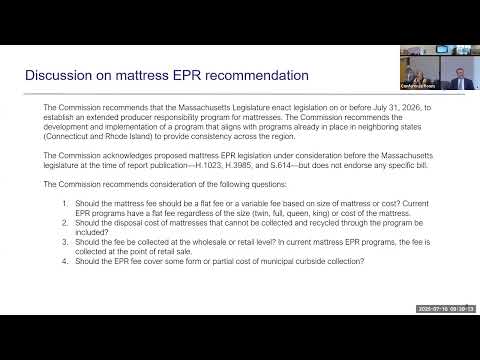
Commission delays formal vote on mattress EPR recommendation to September after extra review requested
Summary
Commissioners reviewed a draft mattress extended‑producer‑responsibility recommendation, debated fee structure and curbside pickup, and agreed to redistribute a revised draft for formal vote in September.
The Extended Producer Responsibility Commission reviewed a draft recommendation for a mattress EPR (extended producer responsibility) program and agreed not to take a formal vote at this meeting. The chair said commissioners had distributed a draft and asked members for clarifying comments before a planned formal vote at the September meeting.
Commissioners and public commenters discussed how a mattress program should calculate fees (for example, by product type or by disposal cost), where fees should be collected (wholesale vs. retail), and whether an EPR program should supplement or replace existing municipal disposal bans. The group also discussed whether a statewide EPR recommendation should reference specific bills pending in other jurisdictions or in Massachusetts.
Why it matters
Mattress disposal has been the subject of earlier commission work and ecosystem participants have opposing views on whether a producer fee should be assessed at retail or wholesale and whether municipal curbside collection should be funded through EPR. Municipal officials told the commission they face ongoing disposal costs and that a producer‑funded program could reduce local taxpayer expense if properly designed.
Key discussion points
- Fee design: Commissioners debated whether fees should be flat, tiered by mattress type, or tied to disposal cost. Some members cited examples from neighboring states and the need to balance implementation complexity against fairness. - Collection point and curbside: Councilor Delgado and others stressed the practical difficulty for residents without transport; participants noted that in other states curbside collection has been treated as premium or optional service because costs vary greatly by municipality. - Legislative references: One commissioner asked whether the recommendation should note that a particular bill before another state aligns with the draft model. The chair said acknowledging similarity is factual but voiced concern about overstepping by formally endorsing a pending bill. - Timeline: The chair explained that group members and stakeholder organizations often require time for organizational approval; the commission therefore chose to defer a formal vote to the September meeting to allow additional review and organizational sign‑off.
Outcome and next steps
No formal vote was recorded at this meeting. The chair directed staff to revise the mattress recommendation to reflect the clarifying comments, redistribute it to commissioners for review, and schedule a formal vote at the September meeting. Commissioners were told the revised draft would be circulated a few days after the meeting to allow time for organizational review.
Ending
The chair closed the mattress discussion by reiterating that the group would take a formal vote in September after redistributing a revised recommendation and allowing time for member organizations to complete their internal approvals.