Get Full Government Meeting Transcripts, Videos, & Alerts Forever!
Get email alerts on the Property Tax Reform topic
No spam. Unsubscribe anytime.
Budget committee advances several real‑property tax bills for further review; director urges coordinated permitted‑interaction review
Summary
Committee members discussed multiple bills that would change home‑exemption amounts, the residential A threshold and incentives for long‑term rental; administration warned of multi‑million dollar revenue impacts and recommended a permitted‑interaction group to analyze fiscal and rate effects across bills.
The Budget Committee on July 21 discussed a package of proposed changes to real‑property tax rules and recommended that several measures proceed to additional hearings while flagging material fiscal impacts. The discussion covered four related matters: Bill 49 (real property home exemption change), Bill 50 (real property home exemption for non‑seniors), Bill 34 (raising the threshold for the Residential A classification), and Bill 48 (long‑term rental dedication and tax relief).
Why it matters: changes to exemption amounts and classification thresholds affect who pays property taxes and how much they pay, with downstream effects on renters, landlords and city revenue. Director Andy Kawano of the Department of Budget and Fiscal Services told the committee that increasing exemptions would reduce tax revenue by millions of dollars and that raising the Residential A threshold would materially change which parcels fall into different tax tiers.
Key numbers and fiscal context: Kawano provided example estimates: raising an owner exemption by $20,000 would reduce city tax revenue by about $70 per parcel; applying that across roughly 79,700 parcels owned by taxpayers age 65+ produces a rough $5.6 million revenue reduction for the city (figure cited in testimony for Bill 49). For Bill 50 (younger owners), BFS estimated roughly $5.1 million in lost revenue for a $20,000 exemption increase across about 72,500 affected parcels. For Bill 34, which would raise the Residential A threshold from $1,000,000 to $1,500,000, Kawano said the Residential A parcel count would shrink from roughly 30,000 parcels to about 6,700 parcels, necessitating substantial rate adjustments if the council wants revenue neutrality.
Discussion highlights: council members asked for more granular parcel‑level data and distributional analysis. Some testifiers supported raising thresholds or exemptions to protect homeowners and long‑term residents; others, including commenters, opposed increases that reduce overall revenue or that benefit wealthy homeowners disproportionately. Director Kawano recommended that council members consider a permitted‑interaction group to review the set of bills together and to model revenue neutrality and rate impacts comprehensively.
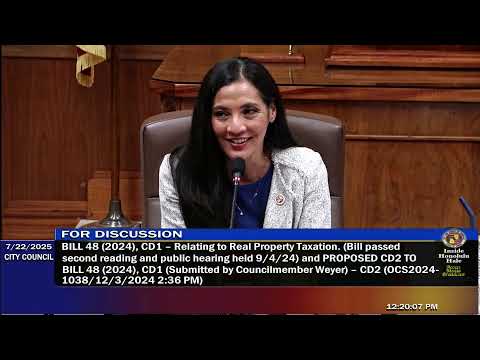
Long‑term rental dedication: Bill 48 seeks to create a mechanism to reduce property tax for property owners who commit units to long‑term rental at affordable rents; the administration noted a key risk — the measure does not in its current form guarantee the tax savings will be passed through to tenants. BFS suggested tying any property tax reduction to affordability requirements (for example, AMI rent limits) and working through the existing Section 8.8‑7.6 dedication framework to ensure rent limits and enforcement mechanisms are clear.
Outcome: Bills 49 and 50 were recommended for second reading and scheduling of public hearings by the committee. Bill 34 and Bill 48 remained under discussion; the administration and several council members requested additional analysis, parcel‑level data and a coordinated review.