
Riviera residents ask Lawrenceburg to consider incorporating private streets; council to study feasibility
Get AI-powered insights, summaries, and transcripts
Subscribe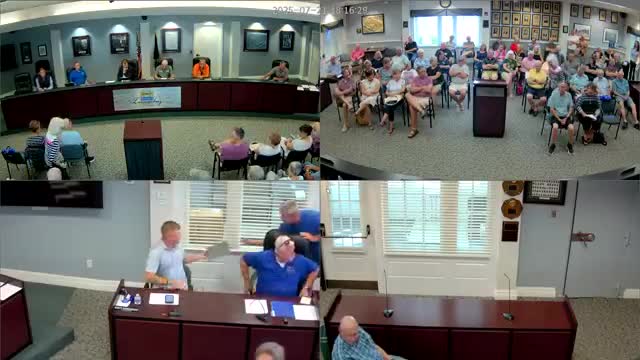
Summary
Residents of the Riviera condominium developments urged the Lawrenceburg City Council on July 21 to incorporate their private streets into the city system, citing rising HOA fees, winter access problems and safety concerns. Council members agreed to research legal and engineering feasibility and aim to report back at the Aug. 4 meeting.
Riviera residents asked the Lawrenceburg City Council on July 21 to consider incorporating the private streets that serve Riviera and Riviera II into the city's public street system, saying rising homeowners association fees and winter access problems are creating a hardship for many longtime, mostly senior, residents.
The request came during the public-comment portion of the council meeting, where more than a dozen Riviera residents spoke. Diana Ward, who identified herself as the Riviera II HOA president, said her community faces rising maintenance costs and may need a special assessment to cover a clubhouse roof and other repairs; she said Fisher, the previous manager, left a reserve of about $32,000. "Please take care of our roads," Ward said. Colleen Ogg, another Riviera resident, said, "We are all taxpayers, and we are all voters, and we would like to have the services that are provided here." Pete Sharp told the council, "All we want is some help — it's not like we're asking for new metal roofs or nothing."
Why it matters: residents who said they rely on Social Security told the council higher HOA fees are likely to force sales, and speakers pressed safety arguments — including inability to clear snow during last winter and concern about emergency vehicle access on narrow or steep private roads. Council members and staff described a distinction between public streets and private streets created under planned unit developments (PUDs), and said taking ownership would require legal and engineering review and possible rehabilitation before the city could assume maintenance responsibility.
Council responses and next steps: Council members said they support investigating whether incorporation is feasible but that the city cannot legally or practically assume maintenance of private streets without meeting statutory and engineering requirements. Council members and staff said the city already has a written PUD instrument for Riviera (cited in the meeting as “Riviera Planned Unit Development, ordinance 154.35” and a recorded declaration in the county records, recorded at “Official Record Book 171, page 1046”), which contains a recorded road declaration. City staff said incorporation is possible in some cases but flagged typical practical barriers: private streets may not meet city construction specifications, and taking a road “as is” could require borings, repaving, drainage work and other capital work before the city could accept it.
City staff and council directed the administration to research legal and engineering feasibility, gather cost estimates and bring formal findings to the Aug. 4 meeting. Council members also referenced the precedent of 3 Mile Ridge, which was incorporated earlier; speakers and council members disagreed at points about what work, if any, was required when that community was accepted. Staff cited potential funding or match options (discussed in the meeting under the label "CCMG") and said an engineering study would be required to determine the condition of the roadbed and scope of work needed.
What was not decided: The council did not vote to accept or decline the request on July 21, and no formal action to transfer streets was taken. Several residents asked whether HOA fees would drop if the city took over streets; council members said they do not have a guarantee that HOA fees would be reduced, and they emphasized that if the city accepts a private area it generally must assume the entire development rather than a partial subset of streets.
Ending: Council members said they would attempt to have a preliminary answer and estimates for the Aug. 4 meeting. Residents were invited to return for that meeting; the council said it would consult legal counsel and is likely to bring in an engineer or planning staff to assess costs and compliance with city specifications.