
St. Pete Beach commission keeps current property tax rate after budget workshop
Get AI-powered insights, summaries, and transcripts
Subscribe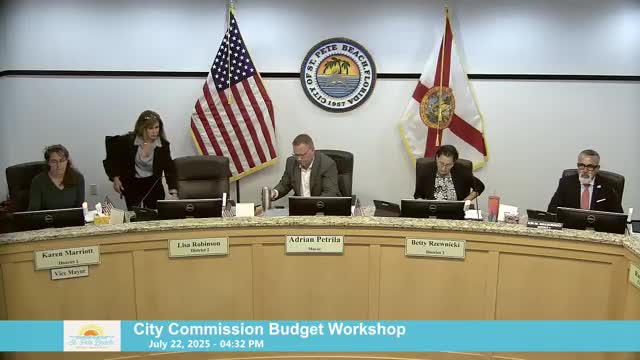
Summary
The St. Pete Beach City Commission signaled unanimous consensus at a July budget workshop to keep the city's current millage rate (3.09) while pursuing other revenue and cost-saving options to fund resiliency and capital needs.
Gavin Schmidt, the finance director for the City of St. Pete Beach, opened the commission's preliminary budget workshop by framing the meeting around property taxes and the city's options for the coming fiscal year. "Today, we are here for our proposed, preliminary budget workshop number 4... the story of ad valorem taxes," Schmidt said as he walked commissioners through how property tax dollars are distributed.
The commission reached a consensus to keep the current millage rate (option A, 3.09) rather than adopt the county-provided rollback rate or higher levy options. The city manager and finance staff told commissioners they must notify Pinellas County of the commission's preferred millage number by a July 29 deadline for use in the city's tentative budget materials.
Why it matters: the millage decision determines how much local revenue the city can commit to capital projects and a new resiliency fund while staff and commissioners also weigh other tools such as special assessment districts, revised user fees and parking-rate changes. City staff presented estimates showing different outcomes: the finance director said the rollback/alternative calculations would change annual city revenues by roughly $140,000 (rollback delta), a majority-vote increase would yield about $860,000 more annually for the city, and a two-thirds-vote maximum would add about $2.5 million annually. Over 10 years, staff projected roughly $8.5 million under the majority-vote scenario and $25.2 million under the two-thirds scenario for combined resiliency and CIP accounts.
Details and budget trade-offs
- Revenue breakdown and distribution: Schmidt reviewed how ad valorem receipts are allocated across jurisdictions and property types, noting roughly 20% of a property tax bill stays in St. Pete Beach while the remaining roughly 80% goes to schools, the county, EMS and special districts such as the Pinellas County Planning Council, the Juvenile Welfare Board and the Southwest Florida Water Management District. He explained homestead exemptions and how homesteaded versus non-homesteaded parcels change assessed values.
- Millage options and short-term impacts: the finance budget review committee recommended a rollback rate of 3.1189, which staff said would generate an estimated $70,000 into the resiliency fund and $70,000 into the capital improvement program (CIP). Schmidt and staff emphasized that the operating budget as drafted assumes the current millage (option A).
- Project priorities and uses: staff presented candidate projects that additional millage revenue could fund. Under the majority-vote scenario the city would prioritize storm-system cleaning and inspection, shoreline-protection improvements, and the Don CeSar boat ramp project. Under the larger, two-thirds scenario staff added several basin resiliency adaptation projects (Don CeSar Basin 3, Bella Vista Basin 1 and Bella Vista Basin 2) in a combined package staff estimated at roughly $24.5 million.
- Other revenues and cost options: staff reported key updates to the revenue picture, including a Pinellas County EMS contribution increasing from $2.9 million to about $3.7 million this year and a separate $700,000 request to replace two rescue vehicles. The budget now shows a distinct "transfer from parking" line after previously rolling parking transfers into miscellaneous revenue. Commissioners discussed non-tax options: limited, neighborhood-targeted special assessments for resiliency work (still at early discussion stages for the Don CeSar neighborhood); storm-water and wastewater rate studies to better fund enterprise activities; and parking-rate changes. One commissioner noted the city's parking receipts are roughly $6 million annually and suggested that raising rates by $1 an hour could generate about $1.5 million more citywide, an example presented as a revenue alternative that would not raise property taxes.
- Personnel and program changes: staff outlined a phase-two reorganization of leadership titles (for example, library director to city librarian; recreation director to resident services director) with no net budget impact. The budget includes a new emergency preparedness coordinator position and continued use of limited-duration building-department staff added after storm impacts. Staff also flagged a proposed test of a per-employee-per-month benefits subsidy to stabilize benefit projections for head-count planning.
Commissioners' views and next steps
Commissioners debated the fairness of an ad valorem increase given residents' post-hurricane financial strain and the long-term scale of infrastructure needs. Commissioner Robinson expressed preference for keeping either the current millage or the rollback rate but opposed raising it above the rollback rate until the commission sees documented performance on spending. Commissioner Maldonado and others urged staff to pursue non-tax revenue measures and to tighten internal spending; Commissioner Marriott said she was not in favor of a pay increase for elected officials and noted that any compensation change would require a referendum and would not take effect immediately.
City staff and the city attorney reminded commissioners that Florida statute allows the commission to reduce the millage rate at will but that reductions change the new baseline for future rollback or majority/2/3 calculations; staff also noted a procedural gap the commission may remedy next year to allow public comment and a formal vote on the millage choice before staff finalizes materials for the county.
The commission directed staff to proceed under the current millage for the tentative budget process and to return with the tentative budget and more detail on reserve policies, insurance (workers' comp/property casualty), parking and user-fee studies, and project reappropriation requests for 2025 projects that span fiscal years. The commission will consider the tentative and final budget hearings on the schedule required by state law and county deadlines.
"If we want to make any changes, we don't make any changes. I'm gonna have to assume that your silence means we're keeping everything the same," Mayor [unnamed] said during the workshop to underscore the July 29 deadline for a millage direction.
Ending
Staff will prepare the tentative budget using the current millage and return to the commission with more detailed revenue and expenditure updates, reserve-policy recommendations and a refined CIP reappropriation list. Commissioners asked staff to present options that raise non-property-tax revenues and to include an opportunity for public comment and a formal recorded vote on millage in next year's process earlier in the schedule.