
St. Pete Beach approves $21,720 study to test CRA eligibility for resiliency-focused tax-increment financing
Get AI-powered insights, summaries, and transcripts
Subscribe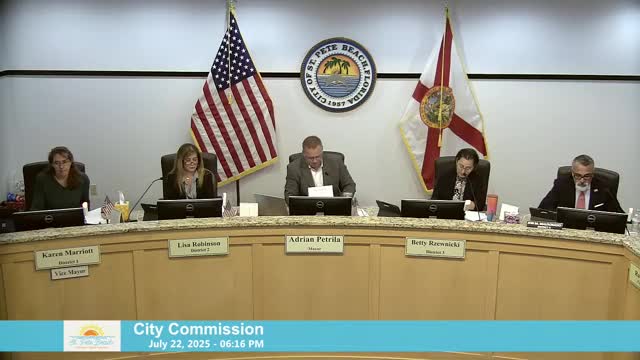
Summary
The city authorized Stantec to prepare a finding of necessity (FON) and study for a potential community redevelopment area (CRA) centered on Gulf Boulevard and nearby blocks; the study would document “blighted” infrastructure conditions and evaluate tax-increment financing (TIF) options to support resiliency projects.
The St. Pete Beach City Commission voted to authorize a $21,720 contract with Stantec to prepare a finding of necessity (FON) and related study examining whether part of the city qualifies for a community redevelopment area (CRA) that would use tax-increment financing to fund resiliency and infrastructure projects.
Laura Canary, community development director, described the request as an early, statutory step to document whether an area meets the blight criteria in Florida law and to assemble evidence for a potential CRA. "The primary purpose of tonight's discussion is to get your approval to move forward with a finding of necessity to assess whether we even come close to being considered for a CRA designation," Canary said.
City planners described the proposed study area as a contiguous band along Gulf Boulevard bordered roughly by 8th Avenue on the north and 30th Avenue on the south; staff said the initial boundary aligns with more than 22 planned capital improvement projects and can be adjusted during the process. Gil Martinez, senior planner, told the commission the proposed CRA would be “resiliency based” and aimed at hardening infrastructure vulnerable to sea-level rise and climate-driven flooding.
How TIF would work: Staff and outside presenters explained that tax-increment financing captures the growth in property-tax revenue above a base year within the CRA and reinvests that increment in the district. Martinez presented an illustrative projection showing how a district could generate increment over a five-year horizon with a county participation share; Canary and staff explained the county must agree to participate before county tax revenues are shared back into a CRA trust fund.
Stakeholder input and concerns: Community commenters and commissioners raised recurring concerns about eminent domain, property impacts, and community buy-in. Resident Deborah Schechner asked whether the CRA could force property sales and whether eminent domain remained a tool. City attorney staff and community development clarified that Florida law and recent legal/legislative developments prevent CRAs from using eminent domain to acquire property for redevelopment; acquisitions must be voluntary. Schechner also urged community workshops and explicit discussion of potential downsides to property owners.
County participation and timing: Canary said the county’s participation rate is typically conservative at 50% for planning purposes but can range higher (up to about 95% in other jurisdictions); she said the city will need to negotiate interlocal agreements with Pinellas County and align CRA projects with county funding priorities. Commissioners debated whether to pause community outreach until results of the FON are in; staff recommended preparing an informational workshop during the study to gather early feedback without raising expectations for immediate redevelopment.
Vote and next steps: The commission authorized the Stantec contract to complete the FON and study by motion; the roll call recorded a 4–1 vote with Commissioner Robinson voting No. Staff said the FON would document conditions and could be used to inform grant applications, a redevelopment plan, and potential interlocal agreements with the county. If the FON supports designation, the next steps would include a redevelopment plan, public engagement, and separate local actions to adopt a CRA and establish a trust fund and governing board.
What the study will not do: Canary emphasized that the FON and the contract do not approve any specific redevelopment or redevelopment plan, and they do not, by themselves, change zoning or authorize property acquisition. The study is an information and eligibility exercise required under Florida law.