
Council sets annual comp‑plan docketing; schedules public conversations after 1,009 signatures and 309 amendment requests on DEI
Get AI-powered insights, summaries, and transcripts
Subscribe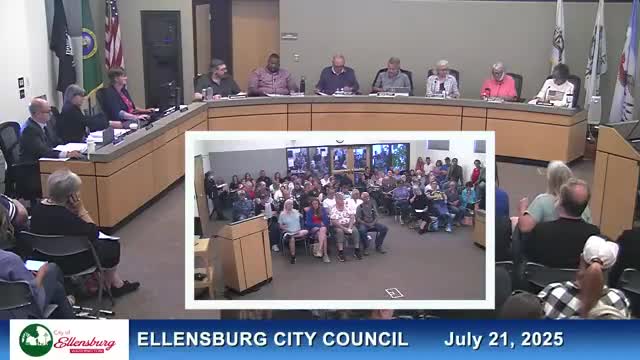
Summary
The City Council agreed July 21 to docket its 2025 annual Comprehensive Plan amendments and to move forward with public engagement after receiving 309 submittals asking that Chapter 9 (DEI) and related policies be removed from the plan.
The Ellensburg City Council voted on July 21 to docket its regular annual amendment to the Comprehensive Plan, including the required six‑year Capital Improvement Program update, and to accept for review a set of community submissions opposing the city’s Chapter 9 (diversity, equity and inclusion) and related policies.
Stacy Henderson, the city’s planning manager, summarized the annual process required by the state Growth Management Act and city code and said staff received 309 related amendment forms before the submission deadline. Those forms largely requested removal of language in Chapter 9 and other DEI policies; staff’s preliminary review categorized the submissions and recommended council docket the items so staff could perform a fuller analysis and engage the public.
Council then discussed a public engagement approach staff proposed to reduce polarization and find areas of common ground. Staff recommended a three‑session format facilitated by moderators trained in structured dialogue: two public community conversations (one weekday evening and one weekend afternoon) followed by a day‑long facilitated common‑ground workshop. Staff provided tentative dates for August and September; the meetings will be open to observers and invite moderated participation from people representing different perspectives.
At the meeting council voted to docket the 2025 annual CIP update and to docket the 309 DEI‑related amendment submissions for further review and public engagement. The docketing step does not change the plan immediately; it authorizes staff to perform analyses, schedule public meetings, and bring draft recommendations back to the planning commission and council later in the year for a final decision. Council members said they hoped the structured dialogues would clarify factual misunderstandings and identify any workable policy adjustments. Staff emphasized that removal of Chapter 9 from the Comprehensive Plan would not, by itself, repeal Ordinance 4871 that established the DEI commission in city code; the commission is codified separately.
Public comment during the item was extensive and spanned both sides of the issue. Speakers in favor of retaining Chapter 9 and the DEI commission stressed that the chapter represents policy protections and planning priorities and pointed to accessibility and safety concerns for marginalized groups. Speakers calling for removal described DEI language as divisive, raised questions about how submissions were collected, and asked for verification and transparency on petitions. Several speakers urged a pause and more fact‑based discussion; others asked the council not to delay a public process.
Council directed staff to proceed with the recommended public conversation schedule and to return draft proposals for commission review and subsequent council action in the fall. The item will return later in the annual amendment schedule for formal planning‑commission review and a final council decision.