
Beaverton public comments highlight sharp divisions over Middle East, free-speech and student safety
Get AI-powered insights, summaries, and transcripts
Subscribe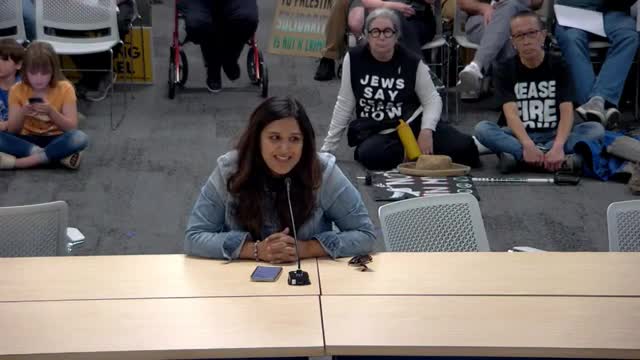
Summary
Dozens of public commenters at the Beaverton School Board meeting raised competing claims about free speech, alleged antisemitism, and student safety, pressing the board to clarify how schools will protect students and respond to controversial speech.
At the June 2 Beaverton School Board meeting, a series of public commenters pressed the board about free speech and safety in schools amid international conflict, saying the district must protect students from harassment while also respecting expression.
Those speaking represented competing positions: some urged the board to defend pro-Palestinian expression as protected speech and to avoid labeling criticism of Israel as antisemitic, while others described repeated antisemitic acts and said Jewish students no longer feel safe in district schools.
The competing remarks were offered during the board's public-comment period and included emotional testimony from parents, students and community members. Asaf Mivrak, a parent with a student at Sunset High School, urged the board to weigh safety and accountability alongside free-speech principles, saying, “Free speech… protects you from the government, not from consequences when your words harm the safety or dignity of others, especially students.”
Student and youth speakers described immediate effects in classrooms. A Findley Elementary student, Brinley, said a petition asking the district to “make schools safer” has drawn more than 1,000 signatures and that no district representative had contacted petitioners; she told the board she still feels frightened at school after an incident with another student. High school student Noam said incidents of antisemitism — including swastikas and taunts — have left some Jewish students feeling unsafe: “I no longer feel safe in my own school,” he said.
Other commenters urged the board to protect the right to voice advocacy against human-rights abuses overseas. Julia Ford, a former public-school student, urged the district to preserve "fact-based educational environments" and said that leading human-rights organizations have documented serious concerns in the region. Commenters on both sides were given two minutes each under the board's public-comment rules.
Board members asked the public to observe the meeting rules and reminded speakers the board documents all comments. The meeting recordkeeper invited speakers to submit full written statements when they ran out of time.
The board did not take immediate action at the meeting on policy changes related to these remarks. Instead, several board members said the district must balance free-speech protections with student safety and the need for a fair investigative process when allegations arise.
The public-comment sequence underscored deep divisions in the community and left the board with a documented set of complaints, requests and calls for clearer guidance. The district may use the written submissions and the public record as the board and staff consider next steps.