Get Full Government Meeting Transcripts, Videos, & Alerts Forever!
Get email alerts on the Environment Air Quality topic
No spam. Unsubscribe anytime.
Salem committee delays gas-powered leaf blower ban amid questions on exemptions, equity and enforcement
Summary
Councilors debated a summer ban on gas-powered leaf blowers proposed by Councilors Davis and Merkel, heard health and operational testimony, and voted to keep the measure in committee while asking the city solicitor to draft exemption and communication language.
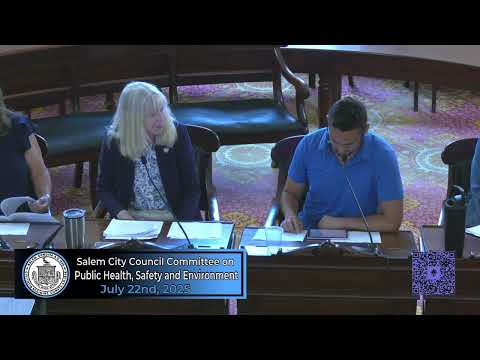
The Salem City Council Committee on Public Health, Safety and Environment on July 22, 2025 voted to keep in committee a proposed ordinance from Councilors Davis and Merkel that would ban gas-powered leaf blowers for part of the year while staff craft detailed exemption and outreach language.
Councilor Davis, co-sponsor of the ordinance, said the measure aims to reduce air pollution, protect outdoor workers and curb noise. “A single hour of operation of a gas-powered leaf blower can produce the same amount of smog-forming emissions as driving a car for 1,100 miles,” Davis said, citing California Air Resources Board figures introduced during the debate.
The proposal would prohibit the use of gas-powered leaf blowers during a summer window (the draft ordinance follows the sponsors’ examples from nearby communities) and would phase in compliance for residents, commercial operators and municipal departments. The council’s discussion focused on three main concerns: municipal exemptions for large or emergency operations, the economic impact and technical feasibility for small landscapers, and who will enforce the rule and how the city will notify affected parties.
Neil Duffy, the city’s Sustainability and Resiliency director, provided written support read into the record and told the council the ban “will not have a significant impact on the city’s overall greenhouse gas emissions, but it will provide improvements to local air quality and reduce noise pollution.” Chair Cohen read suggested edits from City Solicitor Renard that would (1) add hours of operation language and (2) limit exemptions to “municipal departments and their contractors…for routine maintenance,” while instructing departments to minimize noise during residential hours and to consider low-decibel equipment when purchasing replacements.
Department of Public Services Director Ray Joden told the council that current battery technology limits large-field electric operations: “At the top tier batteries that we’re exhibiting right now … we’re running into about 20 minutes of run time per battery,” he said, describing why the department has concerns about replacing backpack and larger blowers for large-scale or emergency cleanup operations.
Police Chief Miller said municipal cleanups often involve overtime for multiple departments and that longer cleanup times would increase costs: “Almost all of these events involve a lot of overtime. The longer that the cleanup takes, the more it costs,” he said, arguing for narrowly tailored exemptions for public events and emergency responses.
Councilors raised equity concerns for landscapers and their employees, who are often lower-income and immigrant workers. Councilor Varela and others asked whether the compliance dates and proposed grace periods would create disproportionate burdens on small businesses; sponsors said the draft separates residential and commercial compliance dates and includes multi-year compliance windows to ease costs and allow attrition-driven replacement of failing gas equipment.
Several residents testified in favor of a ban. Danielle Hanrahan urged the council not to “let the perfect be the enemy of the good” and said manual raking and existing electric equipment can be viable alternatives. Other speakers described noise, dust and health impacts on children and neighbors.
After discussion the council voted to keep the ordinance in committee and asked the city solicitor to prepare redlined language on exemptions (with specific examples such as public-event cleanup and fire or storm response) and a detailed communication plan for residents and commercial landscapers. The committee also requested that the Board of Health be asked to review and provide input; city staff said the Board of Health’s next realistic opportunity to weigh in would likely be in October.
The item remains in committee pending revised language from the city solicitor, a draft communication plan from the Sustainability and Resiliency Department, and follow-up reports from departmental partners including Public Services and Police.