
Council adopts fiscal plans and annexations; staff says updates for SB1 have minimal fiscal impact
Get AI-powered insights, summaries, and transcripts
Subscribe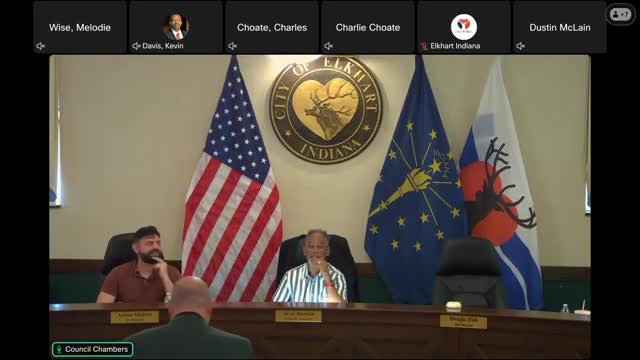
Summary
The Common Council adopted written fiscal plans tied to two annexation proposals — the Wrangler annexation and Elkhart East (Areas C and E) — and staff said updates reflecting Senate Bill 1 had only minimal changes that do not alter fiscal feasibility. Staff estimated modest annual net service costs for the annexation areas.
The Elkhart Common Council on June 3 adopted fiscal plans and resolutions for two proposed annexations and voted to move the annexations forward in the process.
Mike Hubert, Development Services director, briefed the council on updated fiscal plans for the Wrangler annexation (three parcels for single‑family development connected to the Boulder Run project) and for Elkhart East Areas C and E (industrial and commercial land near County Road 6 and County Road 17). Hubert said the consultant Baker Tilly revised the fiscal plans to account for changes stemming from Senate Enrolled Act No. 1 (referred to in the meeting as Senate Bill 1 or SB1). "The senate enrolled act number 1, included a number of changes to both property tax credits and deductions," Hubert said, and staff limited the discussion to real‑property implications for the annexations.
Hubert said the updates produced "very, very minimal" changes overall and did not alter the fiscal conclusion that the annexations will be able to cover the increased service costs through future assessed‑value growth. For the Wrangler annexation, staff said the current assessed value is minimal because the land is vacant; estimated additional service cost is roughly $1,300 annually and projected AV growth would offset that cost. For Elkhart East Areas C and E, Hubert said the annexation area is primarily industrial and commercial, which fall under the 3% tax cap rate and are not subject to SB1 residential deductions; he cited an estimated starting additional annual cost of about $6,000 (with a 3% inflation assumption used in projections).
Council members asked follow‑ups: one asked whether any other nearby developers were seeking assistance (Hubert said he would double‑check); another asked which fire station would cover the annexation territory (Hubert said Station 6). Hubert said Baker Tilly reduced some earlier AV growth assumptions (from 5% to 2%) and retained the 4% controlled levy growth rate in projections; staff said the changes did not produce material fiscal impacts and that annexation would bring additional AV to help mitigate the broader citywide effects of SB1 on tax rates.
Council adopted the fiscal plans and accompanying resolutions by unanimous roll call (8–0). Hubert said the updated fiscal plans were distributed to council the evening of the meeting and that members might not have had time for a detailed review; he summarized the key changes during the hearing.
Staff said the annexations are intended to allow the city to grow its AV base in anticipation of longer‑term SB1 impacts and that community service costs for the annexed areas are currently limited and expected to be offset by development and new tax revenues. The council did not add conditions to the adopted fiscal plans at the meeting.