Get Full Government Meeting Transcripts, Videos, & Alerts Forever!
Get email alerts on the Municipal Finance topic
No spam. Unsubscribe anytime.
Bowling Green council adopts reallocation of unvoted income tax; schedules ballot question on additional levy
Summary
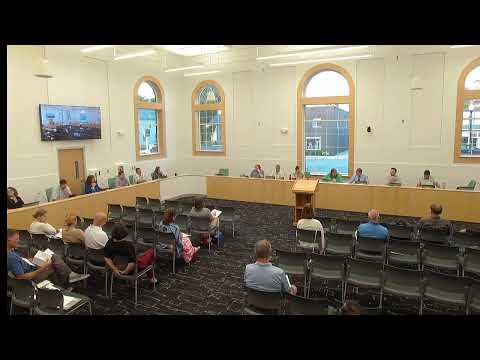
After hours of public comment and council debate over water and sewer rate impacts, Bowling Green City Council adopted an ordinance to redistribute the unvoted 1.5% municipal income tax beginning Jan. 1, 2026, and adopted a resolution to place a proposed 0.15% income-tax increase before voters.
Bowling Green City Council voted to amend how the city allocates its unvoted 1.5% municipal income tax and adopted a resolution to put a proposed 0.15% income-tax increase before voters, after several hours of public comment and council debate about street repairs, utility rates and long-term capital needs.
The council adopted Ordinance 9,287, which changes the allocation table for the existing unvoted 1.5% income tax to redistribute capital funding beginning Jan. 1, 2026. The council also adopted Resolution 3,885 declaring the necessity of an election on a separate proposal to levy an additional 0.15% income tax to fund public safety projects; a related ordinance that would levy the increase was tabled to Nov. 17, 2025.
The vote followed public comments urging the council to increase money for streets, sidewalks and pedestrian safety. “The data shows a real concern that pedestrians do not feel safe crossing certain intersections or walking on the sidewalk with traffic so close,” said Debbie Thompson, who identified herself as living on Chauncey Lane and described organizing a walk audit with 20 volunteers. Jim Evans, who said he sat for multiple half-hour observations downtown, said downtown lacks posted speed limits and marked crosswalk signs. Chris Waterfield described recent work with the Ohio Department of Transportation and cited roughly $2 million grants for several sidewalk and crossing projects.
Council members debated several proposed amendments to the redistribution. Councilman Bill Harold introduced an amendment labeled “Option C” that would have shifted a larger share of the income-tax allocation from water and sewer capital to street repair; that amendment failed on a roll-call vote. Harold then proposed a compromise “Option D” with a smaller shift; that also failed. After the failures, a motion to adopt the administration’s proposed allocation table (the ordinance as presented) carried and Ordinance 9,287 was adopted.
Council members and staff questioned the proposals’ impacts on water and sewer rates. Council President Robinette and Council Member Phipps cited administration materials estimating that a 0.05 percentage-point shift would generate roughly $666,000 annually; using figures discussed in the meeting, Council Member Phipps said an earlier proposal translated to about a $5.40 monthly increase for the average water/sewer bill and that one variant would raise that estimate to about $7.20 monthly. The city’s public utilities director told council staff ran multiple scenarios, reviewed recent capital spending and tried to balance utility-rate impacts with capital needs.
Council also pressed staff on stormwater and combined-sewer issues. Public infrastructure staff said the city currently complies with Ohio EPA permits for wastewater and stormwater and noted Bowling Green has a single combined-sewer overflow point and storage and treatment capacity that staff said reduces the urgency of immediate large-scale separation projects under current permit conditions.
The council’s adoption of Resolution 3,885 sets the formal step for an election on whether voters will approve the separate 0.15% tax increase to fund the city’s department of safety and pay related debt. At the same meeting, Council tabled Ordinance 9,288 — the ordinance that would levy that extra 0.15% — until Nov. 17, 2025.
Supporters and opponents repeatedly asked for clearer math and more time to review options. Council members said they had discussed the subject for months and that the administration had run multiple scenarios; some members nonetheless said they preferred the administration’s plan as a cautious approach. The council’s action rebalances the existing unvoted tax allocations; whether voters approve the separate 0.15% increase will determine additional revenue for the proposed safety projects.
Less-critical wrap-up details: the ordinance text amends section 95 A.1 of the city’s codified ordinances to change allocation percentages, and the changes are scheduled to take effect Jan. 1, 2026, if implemented as described in the ordinance and accompanying resolution.