Get Full Government Meeting Transcripts, Videos, & Alerts Forever!
Get email alerts on the Floodplain Management Nfip topic
No spam. Unsubscribe anytime.
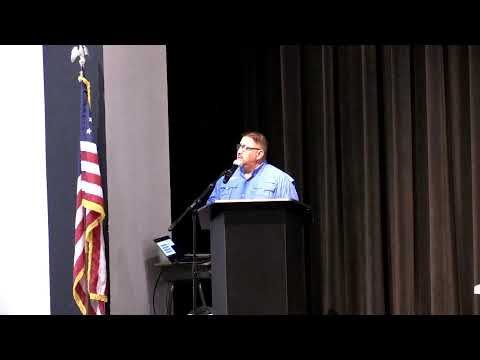
Texas Water Development Board, Kerr County staff brief residents on NFIP, permits and substantial-damage rules
Summary
Texas Water Development Board and county staff explained the National Flood Insurance Program, what it means to be a participating community, and how FEMA's substantial-damage rule (50% threshold) affects rebuilding and permitting after the flood.
KERRVILLE, Texas — Representatives from the Texas Water Development Board joined Kerr County staff to explain the National Flood Insurance Program, how communities participate, and the county’s process for substantial-damage and permitting determinations after the recent flood.
A Texas Water Development Board representative told residents the NFIP was created in 1968 to map flood hazards, set minimum development standards and provide federally backed flood insurance. The speaker said participation is voluntary for counties and cities but provides residents access to federally backed insurance and can affect eligibility for federal grants or loans. “When you're not a participating community... residents that live within your community no longer have access to that federally backed insurance,” the TWDB representative said.
County staff explained categories used to assess damage and the county’s process for handling permits. Officials described three broad groups: structures clearly outside the regulatory floodplain; structures inside the floodplain whose finished floor elevation already meets the current one-foot-above-base requirement; and structures that do not meet that elevation and therefore fall into the most intensive review category for substantial-damage determinations.
A TWDB representative explained FEMA’s substantial-damage threshold: a structure is considered substantially damaged when the cost to repair equals or exceeds 50% of the structure’s pre-damage value. The presenter gave an example: a home with a $60,000 value that sustained $35,000 in damage would meet the substantial-damage definition even if volunteer labor or donated materials reduced the homeowner’s out-of-pocket cost. “You still have to consider the value of that repair,” the TWDB representative said, because donated labor does not change the repair value for the determination.
County staff urged residents with damage to register with the Texas Department of Emergency Management’s Individual State Assessment Tool (I-STAT) and to follow up with FEMA, including visits to the Disaster Recovery Center. The county noted FEMA had established a Disaster Recovery Center at Kerrville First Baptist Church and that the location is expected to move to B.T. Wilson Elementary; FEMA will issue a press release before the move. Staff also said providing elevation certificates or surveys for homes above the base-flood elevation can fast-track permits when applicants can show finished-floor elevations meet the required one-foot margin.
Officials reminded residents that permits and elevation certificates are administrative tools the local floodplain administrator uses to determine compliance and to document substantial-damage or substantial-improvement calculations. The TWDB presenter offered technical assistance and model ordinance language to help counties and cities remain in the NFIP and explained that communities that do not participate may lose access to certain federal funding and insurance for residents.
Ending: TWDB staff said they would be available after the presentation to meet with residents and county staff for follow-up questions and guidance on permits, substantial-damage determinations and program participation.