Get email alerts on the Transportation topic
No spam. Unsubscribe anytime.
Fairview approves $1M match for I‑40 Exit 182 lighting; board asks for crash data and schedules workshop
Summary
The board approved a local agency agreement with TDOT for a 50/50 interchange lighting project at I‑40 Exit 182. TDOT estimated total cost above $2 million (city share roughly $1 million); design and construction are multi‑year. Commissioners requested additional crash and safety data and scheduled a workshop before final commitment.
Fairview, Tenn. — The Fairview Board of Commissioners voted 4‑1 on July 17 to authorize the mayor to execute a local agency project agreement with the Tennessee Department of Transportation (TDOT) to pursue interchange lighting at I‑40 Exit 182.
TDOT officials described a conceptual lighting plan that would install high‑mass poles to illuminate ramps, merges and other conflict points at the partial cloverleaf interchange. The department presented a preliminary cost estimate just above $2,000,000; at the customary 50/50 cost share the city’s share would be roughly $1,000,000. TDOT staff said the project would be programmed for construction in fiscal year 2028 and estimated roughly 24 months of project development followed by 12–18 months for construction.
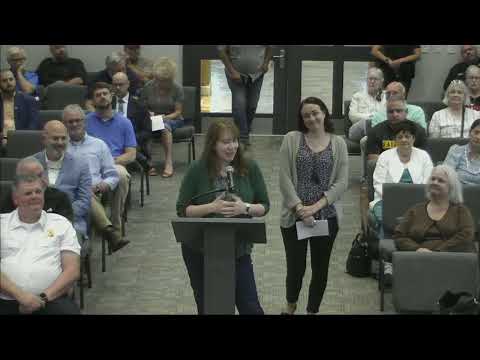
Economic development officer Patty Carroll introduced the proposal, saying the project could improve safety and the gateway appearance where motorists enter Fairview. TDOT’s traffic design manager Caleb Smith and program manager Danielle Haigwood described the photometric concept, the focus on conflict points (exits/merges/diverges) and the agency’s construction schedule. TDOT said similar projects have crash‑reduction benefits and provided a recent local example in Murfreesboro; the department offered to supply published crash‑reduction factors and site‑specific crash history on request.
TDOT gave these high‑level details the board: a preliminary concept with about eight high‑mass light poles (shown in TDOT's photometric), a conservative total estimate above $2,000,000, a likely FY‑28 construction window (after design and letting), and a recurring local utility cost estimated at $360–$450 per month. TDOT also said the city would typically contract with the local electric provider to maintain the installed lighting; ownership and insurance would rest with the city once accepted.
Several commissioners voiced support for the safety rationale; others urged more data before committing bond funds. Commissioners asked TDOT for (a) the crash history at the interchange (time‑of‑day, severity), (b) national/state crash‑reduction factors tied to lighting projects, and (c) comparisons to similar communities. TDOT said it could provide the crash history and published Federal Highway Administration material showing crash‑reduction factors and offered to return with more detailed figures.
The board also discussed the city’s bond spending deadline (12/15/2026). City Manager Tom Doherty and bond counsel advised that bond proceeds could be committed in time and held in an investment account while TDOT completes design; they confirmed bond counsel deemed this an allowable use. TDOT said the city would be required to deposit its estimated local match when the contract is executed; cost overruns, if any, would likely be requested nearer to construction (around FY‑27/28) after bidding.
After discussion a motion to defer for a workshop was proposed but failed; the board then approved the local agency agreement authorization 4‑1. A workshop was still scheduled for Aug. 21 at 6 p.m. so the board can review TDOT’s crash data, updated cost information and the bond accounting detail before finalizing the city’s deposit and execution timeline.
Why this matters: the project offers a 50/50 matching opportunity to improve safety and the community gateway, while obliging the city to provide roughly a $1 million capital match and ongoing utility costs; commissioners emphasized the need for data to assess safety benefits against the budget and competing uses for bond proceeds.
AI generated
The text on this page is AI generated. Summaries, highlights, analysis, and video transcripts are all produced from the original source material.
AI can make mistakes, so if you spot one, and we will fix it for everyone.
Note: the source content is unaltered by us. Any content source we link to, be it a video, an audio recording, or a document, is presented exactly as its publisher released it. That publisher is usually a government body, sometimes an individual official or another organisation.