Get Full Government Meeting Transcripts, Videos, & Alerts Forever!
Get email alerts on the Charter Review topic
No spam. Unsubscribe anytime.
Charter review panel outlines broad rewrite as residents raise concerns about representation, services
Summary
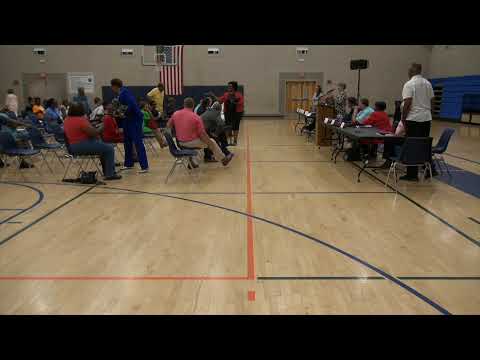
A public hearing for Augusta-Richmond County’s charter review committee featured a presentation by the Carl Vinson Institute of Government and more than a dozen residents who urged careful, transparent changes on issues including form of government, districting and local services.
The Augusta-Richmond County Charter Review Committee opened a public hearing in Augusta to present its review process and gather public input on proposed changes to the consolidated city‑county charter, including removing outdated or duplicative provisions and deciding which matters belong in ordinance rather than the charter.
The panel’s consultant, Dr. Rex Facer of the Carl Vinson Institute of Government at the University of Georgia, told attendees the committee has focused so far on eliminating “anticipatory language,” material duplicated by state law and provisions better handled in ordinances. “As of yesterday, we had over 1,100 responses,” Facer said of a public survey the committee is using to gather feedback.
The hearing was largely a forum for residents to raise concerns that range from how the government is structured to everyday services. Gayla Keese, co‑president of the League of Women Voters of the CSRA, urged clear, neutral survey design and stronger safeguards for veto authority if it is included in the charter. “Several of the survey questions were overly narrow and appeared to suggest a desired response,” Keese said, adding that the review should prioritize transparency and wide consensus.
Several residents pressed the committee about the larger questions the review could decide, including whether to keep a form of government with multiple commissioners or move to fewer, citywide seats. Multiple speakers referenced recent discussions about a strong‑mayor versus manager or administrator model and about changes in district lines. “We want to change to a strong mayor. We got a great form of government. All we need to do is tweak the things that need to be tweaked,” said one resident, while Commissioner Alvin Mason, who spoke at the hearing, cautioned against rushing revisions: “I’m not interested in how fast it gets done. What I’m interested in is how right it gets done.”
Public comment also focused on basic services and economic development. Jonica Mitchell, a resident who spoke about retail and grocery access on the East Side, warned that money spent in neighboring North Augusta reduces local sales tax revenue: “If you’re spending your sales tax in North Augusta, the money’s not here for us to get the things that we need.” Other speakers described a perceived lack of sidewalks, street lights and neighborhood retail, and several said weak school performance and limited nightlife discourage people from moving to Augusta.
Committee members and staff clarified the review process: the panel, appointed by the commission and mayor, will post proposed changes to the CRC website as they are drafted; recommendations will be shared simultaneously with the Augusta commission, the local legislative delegation and the governor’s office; changes that require statutory authority must be approved by the General Assembly and, where applicable, will return to voters for final ratification. Dr. Facer said the committee has already voted to remove large sections of the charter it deemed anticipatory, duplicative of state law or more appropriate for ordinances—an effort the panel estimated removed roughly 100–120 pages from the working document.
Members of the public sought details about appointments and conflicts of interest on the review committee; committee members said district commissioners nominated representatives from each of the 10 commission districts plus a mayoral appointee and that appointees were screened against other board memberships. Residents pressed for broader outreach beyond the CRC website and urged printed or broadcast outreach to reach people without internet access.
The committee said public feedback will continue: meetings occur every other Thursday with subcommittee meetings on alternate days, and the panel encouraged residents to complete the online survey and attend future hearings. No formal charter amendments were adopted at the hearing; the session served to gather input and report interim decisions the committee has already made.